Is This Set Licensed? How Unlicensed One Piece Cards Get Made
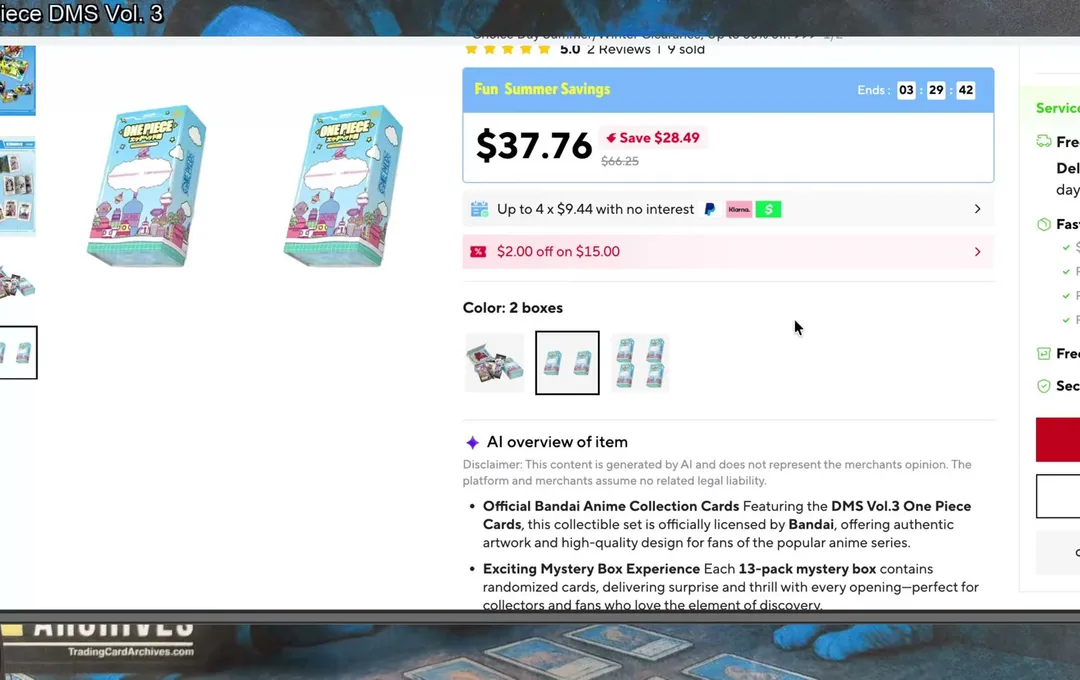
That’s a screenshot from the AliExpress listing for the box I opened this week. Read the overview text: “officially licensed by Bandai.” It is not. It’s not licensed by anybody. That claim is sitting on the sales page for a product that Toei Animation, Eiichiro Oda and Bandai have never seen a yen from, and it will still be sitting there next month.
This is the mess I want to explain today, because some version of “is this set licensed?” is the question I get more than any other. It shows up in my email, in my eBay messages, and in the comments on basically every video. A viewer asked me a much better version of it recently — not is it licensed, but how is this even possible? How does a company print thousands of gorgeous unlicensed One Piece cards, ship them all over the world, and have nobody stop them?
I have an unusual amount of experience with that question, so we had a very long conversation about it, and then I made a very long video about it, and now here’s the written version with the parts I got wrong fixed.
- What “Doujin” Actually Means
- How to Tell If a Chinese Card Box Is Licensed
- Why You Should Listen to Me (A Little)
- A Copyright Is a Ticket, Not a Shield
- China Is Not the Lawless Part
- Why Nobody Bootlegs Disney
- Print a Set, Dissolve the Company, Repeat
- The Exclusive That Built the Black Market
- What Happens in Five Years
- Why I Still Open This Stuff
- The Box: One Piece DMS Vol. 3
- Conclusions
Here’s the video, if you’d rather hear me ramble through it. The box opening starts at 24:01 if you want to skip the lecture:
What “Doujin” Actually Means
Doujin (同人) is a Japanese word that roughly means homemade — self-published, fan-made work. I use it for products like this because it’s a bit kinder than “bootleg,” and because the people making these cards are frequently genuine artists doing genuinely beautiful work. But let’s not be precious about it: this is an unlicensed product. Toei Animation and Oda co-own One Piece, and they didn’t get paid for this box.
It’s worth separating three words that get thrown around interchangeably, because they’re legally very different animals.
A counterfeit is a fake of a specific real thing. There’s an authentic item, and there’s a copy pretending to be that item. Like these:
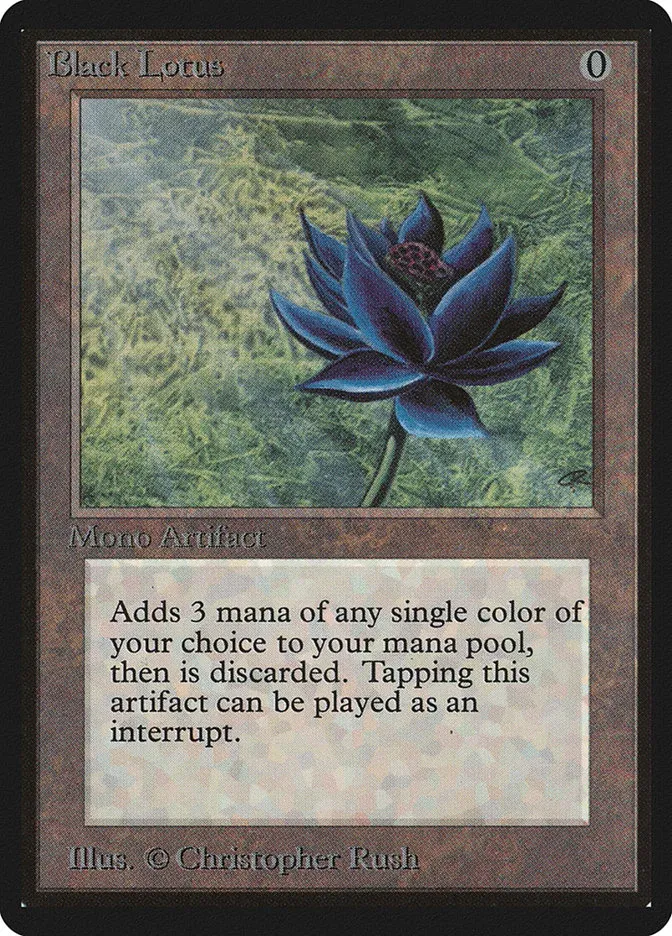
That’s from my proxy Magic cards experiment — $20 to an AliExpress seller who asked not to be named. They printed the Scryfall scan, black border and all, straight onto modern card stock.
A bootleg is an unauthorized product that isn’t pretending to be an existing one — the One Piece t-shirt at your local flea market. Nobody thinks Toei printed it. It’s just using art it has no right to use.
Doujin card sets are the second thing. There is no “real” DMS Vol. 3 that this is a fake of. It’s an original product built out of somebody else’s characters. That distinction matters more than it sounds like it should, because counterfeiting is often a criminal matter with police attached, while pure copyright infringement usually is not — and that gap is most of the story.
Oh, and one more wrinkle before we go further: licensed doesn’t always mean what you want it to mean. Most people assume it does, so let me pick the example that convinced me otherwise.
Bob Ross cards — the Cardsmiths ones — are completely, unambiguously licensed. Nothing is wrong with them. And Bob Ross’s son gets nothing.
Bob Ross Inc. was founded in 1985 as a four-way equal partnership: Ross, his wife Jane, and their business partners Walt and Annette Kowalski, 25% each. In 1994 Ross set up a trust meant to keep his intellectual property in the family — 51% to his brother, 49% to his son Steve. The problem was that the commercial rights to his name, image, voice and creative works had already been signed over to the company while he was alive. Steve sued in 2017 and lost in 2019, and the court’s reasoning was brutally simple: the trust couldn’t hand over what it never had. As the ruling put it, “Plaintiff would not own the intellectual property at issue because the Trust never owned it.” He later settled for the ability to do business under his own name.
So every time one of those cards sells, the paperwork is spotless and the family the brand is named after is not in the transaction at all. “Licensed” tells you somebody had the legal right to sell it. It does not tell you the artist, or anyone who loved them, ever saw a cent.
How to Tell If a Chinese Card Box Is Licensed
Right, the practical part. You don’t need me to research every set for you — a licensed Chinese card box tells on itself, and once you know what to look for it takes about five seconds. Here’s the back of a Card.Fun Disney box:
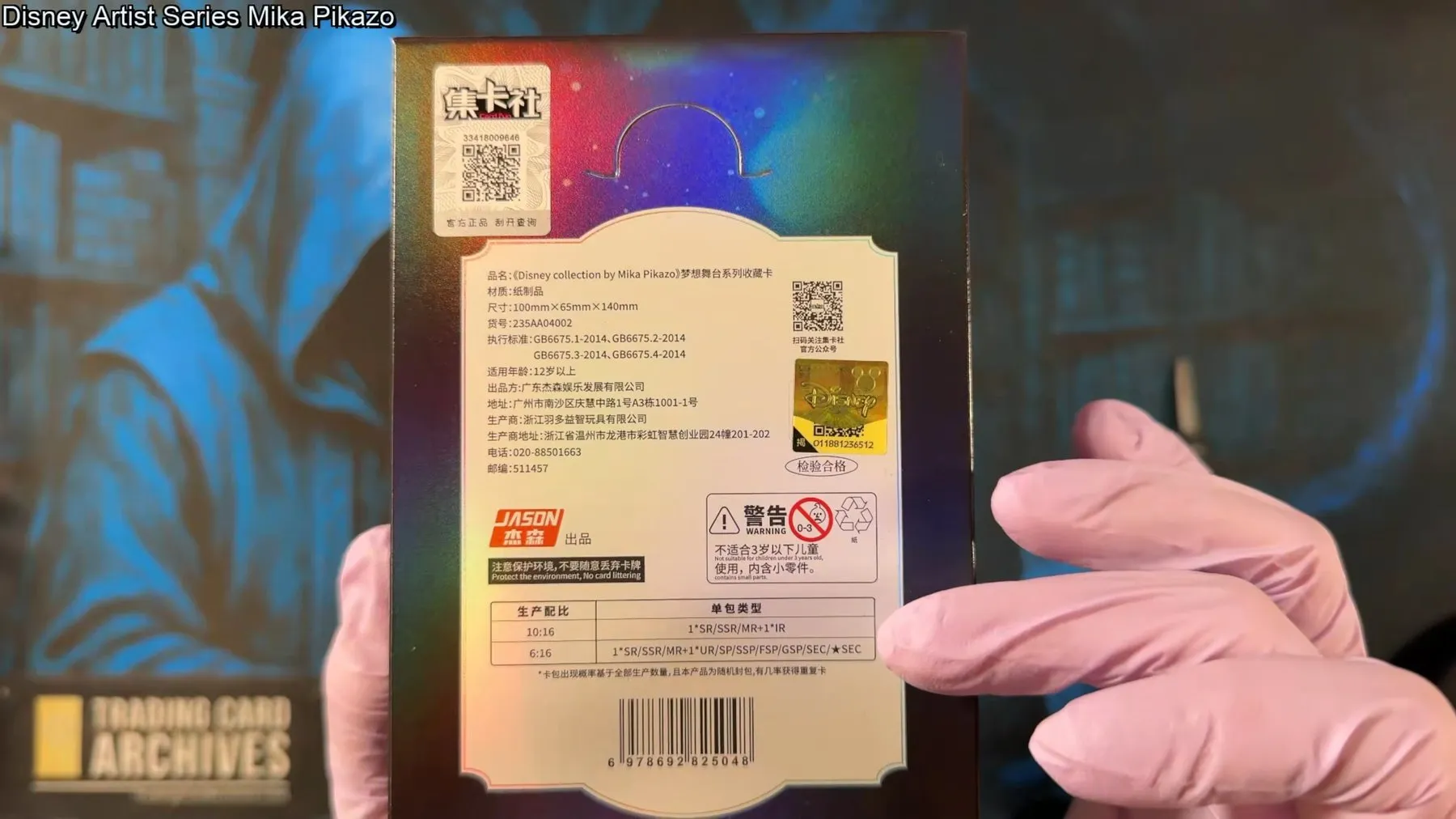
Look at everything happening on that panel:
- Top left, the scratch-off hologram — 官方正品 刮开查询, “official genuine product, scratch to check,” with a serial number and a QR code. That’s the publisher’s own anti-counterfeiting verification. You scratch the panel and check the code.
- Right, the gold Disney hologram — serial 01881236512, with 检验合格 (“inspection passed”) beneath it. That’s the licensor’s mark. Disney puts that there. It’s the single most important thing on the box.
- Bottom left, JASON 杰森 出品 — 出品 means “produced by.”
- The fine print — the 出品公司 (publishing company) is 广东杰森娱乐发展有限公司, Guangdong Jason Entertainment Development Co., Ltd., with a Guangzhou street address and a phone number. Below it, a separate 生产商 — the factory in Zhejiang that physically printed it. Then GB6675 toy safety standards, a barcode, and a printed pull-rate table (10:16 and 6:16, with the exact rarity strings).
That’s what a company standing behind its product looks like. A real legal entity, at a real address, with the licensor’s serialized hologram and its own verification system, disclosing its odds.
Now go look at a doujin box. No licensor hologram. No registered company name. No address. No phone number. Often no barcode. Certainly no pull rates. The DMS box has a logo — 东漫社, the “DM” you see on the flier — and essentially nothing else.
While we’re here, the corporate chain on that Disney box is worth untangling, because I got it wrong on camera. Jason (杰森娱乐 / Guangdong Jason Entertainment) is the publisher. Card.Fun is its trading card brand — sold domestically in China as 集卡社, Jikashe. Jason holds licenses from Disney, Universal, Warner Bros. and Takara Tomy. On the video I described Jason as a company that helps foreign rights holders enforce copyright inside China. That’s not what they are; they’re the licensee. But hold that thought, because the correction turns out to be more interesting than what I originally said.
Why You Should Listen to Me (A Little)
Honestly? Maybe don’t. I’m a guy who opens trading cards on the internet, and I am definitely not a lawyer.
But I have done this work. In 2019 I was a Senior Director of Software Engineering at Niantic, and I was the primary technical investigator and lead signing witness in Niantic, Inc. v. Global++, No. 3:19-cv-03425 in the Northern District of California — the case against the group selling hacked versions of Pokémon GO. My declaration is cited 37 times in Niantic’s motion for preliminary injunction. It ended in January 2021 with a consent judgment: $5 million and a permanent injunction, and Global++ shut down for good.
For a laugh I recently asked Gemini who the lead signing witness for Niantic was in that case. It said it didn’t know. I asked whether it could read the court documents and work it out. It went and read them, and it found me. Everything I’m about to describe, I learned by doing the expensive, unglamorous version of it for a company that could afford to.
That’s the whole lens here: I’m not telling you how copyright works in theory. I’m telling you what it costs.
A Copyright Is a Ticket, Not a Shield
On the video I opened by saying you get a copyright by registering it, and that a copyright is just a piece of paper. Someone quite reasonably pointed out that copyright is automatic. They’re right — and I want to fix this carefully, because the correction is less comforting than the mistake.
Under the Berne Convention, which China joined in 1992 and the US in 1989, copyright exists the moment you create the work. No forms, no fee, no registration. You draw it, you own it.
Now try to do something about it.
In the United States you cannot file a copyright infringement lawsuit until the Copyright Office has actually registered your work. That’s 17 U.S.C. §411(a), and the Supreme Court closed the last loophole in it unanimously in Fourth Estate v. Wall-Street.com in 2019 — an application isn’t enough, you need the completed registration in hand. And under §412, if you didn’t register before the infringement started (or within three months of publication), you’re barred from statutory damages and attorney’s fees. Which means you’re suing for provable actual losses, out of pocket, against someone who probably has less money than your lawyer costs. Most people simply never file.
You can see this in my own case file. When Niantic sued Global++, the very first count in the complaint was copyright infringement — and alongside the complaint, counsel filed an AO 121 form, the mandatory “Report on the Filing of an Action Regarding Copyright” that goes to the Register of Copyrights. Our lead counsel’s declaration had to authenticate the copyright registrations themselves as exhibits. Niantic didn’t win because it had created the work. It won because it had registered the work, years earlier, and could put the certificates in front of a judge.
In China the rules are a little softer and the practical answer is the same. Registration with the Copyright Protection Center of China is voluntary — but a registration is treated as prima facie proof that you own the thing, and without one a foreign company has to prove authorship using foreign documents that need their own notarization and authentication before a Chinese court will even look at them. Every rights lawyer I’ve ever read on this says the same thing: register in China, even though you don’t have to.
So my “it’s just a piece of paper” line was wrong in the details and right in the spirit. The paper isn’t your right. The paper is your ticket into the room where you can spend money defending your right. Take a copyright certificate to your local police station and see how far it gets you.
And that money is not small. In our case, Niantic’s CTO put the company’s anti-cheat spending at over $2 million a year, with roughly 2,000 engineer-hours and about $1 million spent responding to these specific programs. That’s before lawyers. That’s the actual price of enforcement, and it’s why enforcement only happens when there’s a lot of money on the table.
China Is Not the Lawless Part
Here’s where I have to push back on the most common assumption in my comment section — I used to hold it myself. Look at the table of Chinese bootlegs in front of me and the obvious conclusion is that China doesn’t do copyright. That conclusion is wrong.
China enforces intellectual property harder than the United States does, in two specific ways.
On volume: Chinese courts concluded more than 2.5 million first-instance IP cases between 2021 and 2025 — roughly half a million a year, and up 64% over the previous five years. US federal IP filings aren’t in the same universe.
On tools: China has an administrative enforcement track that the US basically doesn’t have. Copyright administrations and market regulators can inspect, seize and fine without anybody filing a lawsuit. Since 2005 the National Copyright Administration has run an annual campaign called Jianwang (剑网, “sword net”) alongside the Ministry of Public Security and two other agencies. In the 2017 campaign alone they inspected 63,000 websites and premises, shut down 2,554 sites, and confiscated more than 2.76 million printed items. There is no American agency that will go raid a print shop because you asked nicely.
So can Toei sue a Chinese card company in a Chinese court? Yes. I said on camera that they couldn’t — that Chinese courts won’t hear a foreign plaintiff. That’s flatly wrong, and I’m glad to correct it. Berne guarantees national treatment; foreign rights holders sue in China constantly and win.
What’s true is that the door is expensive to walk through:
- You must retain PRC-licensed counsel. Your regular lawyers cannot appear.
- Your corporate documents and power of attorney have to be notarized and then authenticated. This actually got substantially cheaper very recently — the Hague Apostille Convention came into force in mainland China on 7 November 2023, replacing the old consular legalization slog with a single apostille. Before that it was months.
- Everything gets translated into Chinese by a translator whose seal the court will accept.
- And the one that actually kills these cases: to prove the infringement, you generally need a notarized purchase. A Chinese notary physically goes with your investigator, watches them buy the infringing product, seals it in evidence and issues a certificate. Per product. Per seller. Per defendant.
Now price that out against a card company that will have dissolved before you’re served. Toei could sue. Anybody who looks at that invoice passes, and they’re right to.
Why Nobody Bootlegs Disney
I follow this industry obsessively and I have never once seen a bootleg Disney card come out of China. Not one. Meanwhile I have a table full of unlicensed One Piece. Same factories, same machines, same everything — and one franchise is simply untouchable.
Disney owns 43% of Shanghai Disney Resort. The other 57% belongs to Shanghai Shendi Group, which is owned by the Shanghai municipal government. When you infringe Disney in China you aren’t just annoying an American entertainment company, you’re devaluing an asset the state has a majority stake in. That is a fundamentally different phone call.
And the consequences are real. In January 2024 the Shanghai Pudong New Area court sentenced three people for counterfeiting Disney children’s clothing: the ringleader got four and a half years in prison and a 5.5 million RMB fine, his partner three years and 3 million RMB, a third man a suspended sentence. They’d moved over 830,000 counterfeit garments for more than 17 million RMB. Police raided the warehouse in Henan and seized about 200,000 pieces.
And here’s the detail that ties this whole article together. The case started because a customer noticed the product was missing its Disney anti-counterfeiting code. That hologram I pointed at on the Card.Fun box, the one with the serial number? That’s not decoration. That’s the thread a consumer complaint pulled to unravel a criminal prosecution.
Now, how much of Disney’s clout is formal legal process and how much is a phone call — that part is trade rumor and I’ll label it as such. But the fear is absolutely real, and I’ve been on the receiving end of it. When I had a set of Star Wars CCG cards professionally printed in China, I sent the printer the actual signed agreement that the Star Wars CCG Players Committee holds with Disney permitting continued printing of that game. They read it. They printed the cards. And they still refused to put the Imperial and Rebel logos on the backs. A licensed, documented, contractually permitted job, and they would not touch those two logos. That’s what deterrence looks like from the inside.
This is where my Jason correction gets interesting. The reason Disney has teeth in China isn’t that it hired an enforcement agency — it’s that its rights live inside a Chinese company with revenue on the line. Jason is the one being undercut if a fake Card.Fun Disney box appears. Jason has local standing, local counsel, local relationships and a direct financial motive. Disney’s real trick was picking a licensee big enough to fight on its behalf.
Toei has a Chinese subsidiary and could do something similar. It has never had a reason to bother, because of the licensing decision we’re about to get to.
Print a Set, Dissolve the Company, Repeat
The other half of the problem is that making a box like this is easy. This is a genuinely beautiful product — heavy stock, foil, sensible distribution, artwork I’d hang on a wall — and it is cheap to produce. There are thousands of print shops in China that will run it for you. Look at the flier for the sketch cards in this set:
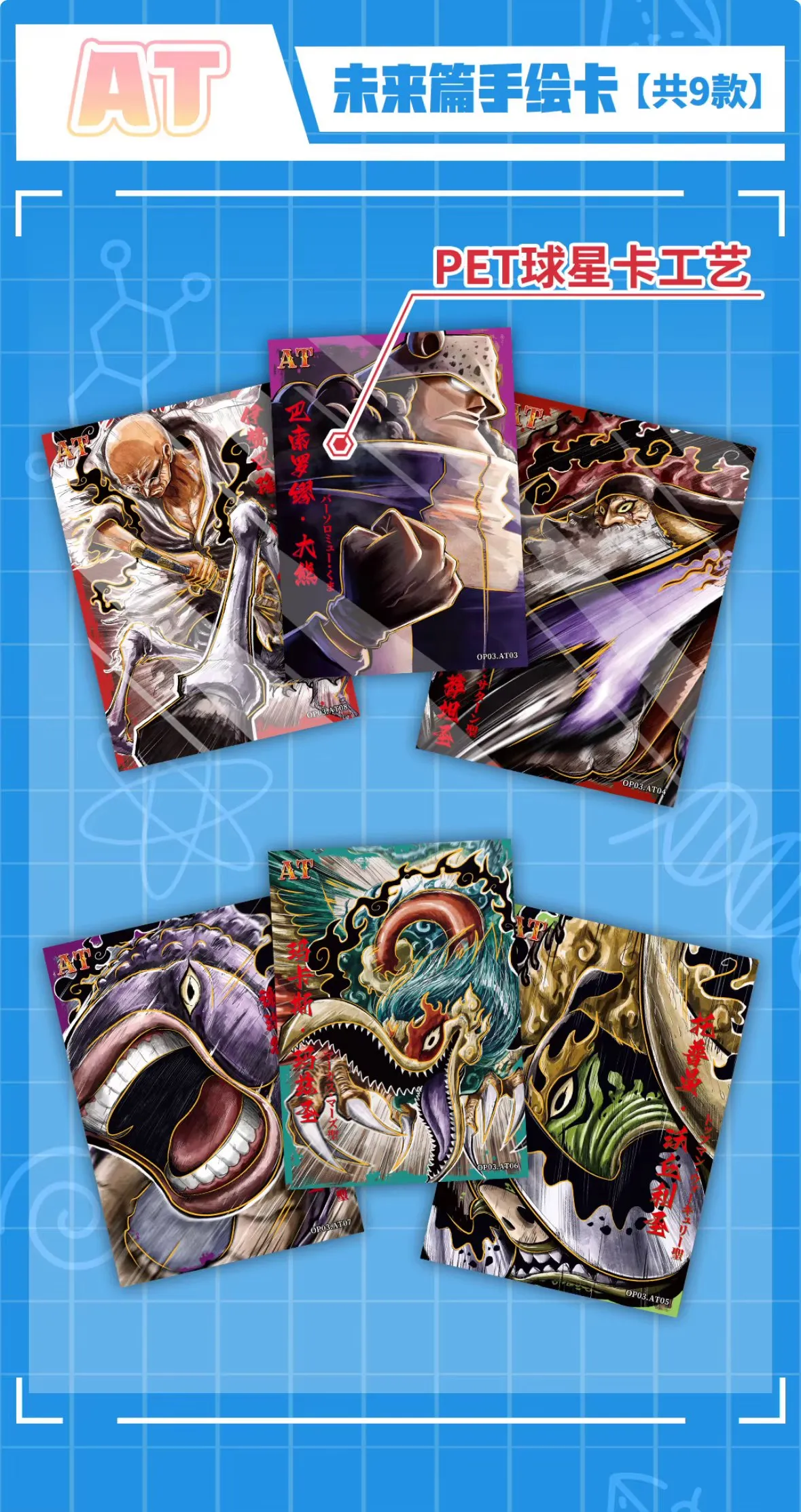
See that red text? PET球星卡工艺 — “PET sports-card process.” They’re advertising, on the flier, that they’re using the same manufacturing technology as licensed sports cards. Because they are. These come off the same machines Topps and Panini product comes off.
I know exactly how easy it is because I’ve done it. I’ve had Magic proxies made, and I’ve had an entire custom Star Wars CCG set printed — cards my friends and I designed ourselves in Photoshop, cards that Decipher never made and never would have made, proofed back and forth with a printer until they were right. If a guy in Los Angeles can get a custom card set professionally printed for a game that’s been out of print for two decades, a real company in Guangdong can do anything it likes.
Which brings us to the thing that makes enforcement genuinely hopeless: who do you sue?
DMS is 东漫社. That’s a name, so you could name them in a complaint. But these companies print a set or two and dissolve. They don’t really vanish — they reincorporate under a new name and print another set. Kabog Animations made One Piece Endless Treasure, one of the most beautiful card series ever made in any country, eight box releases with over 500 unique cards each. They’re gone. Through my friend The Trading Card Collector, who imports cases directly and knows people on that side of the supply chain, I know Kabog disbanded and is reforming under a new company — I don’t think any of their new releases have reached us yet.
So you hire someone like me. I investigate. I come back and tell you the company that printed this no longer exists, its directors are in a new company printing a Bleach set, and the notarized purchases you paid for name a defunct entity. Congratulations, that’ll be my invoice.
The Exclusive That Built the Black Market
Here’s the part I’ve changed my mind about, and it’s the most important idea in this article.
I’ve been saying for years that I’m shocked Kayou or Card.Fun hasn’t licensed One Piece. One licensed One Piece set from Kayou would outsell every doujin box on my table combined — I’d buy it the day it dropped and so would you. So why hasn’t it happened?
I don’t think it’s an oversight. I think the licensing structure created this market.
Compare how the two companies operate. Disney slices its rights finely: by category, by region, by product type. Cards to one partner here, collectibles to another there, a different arrangement in another market. That’s why you see so many licensed Disney card products, from different publishers, region to region — and why there’s no gap for a bootlegger to fill.
Japanese rights holders tend not to work that way, and One Piece looks like the extreme case. As best I can tell, Toei handed “cards” to Bandai as a single global exclusive. And Bandai does exactly one thing with it: the One Piece Card Game, plus some wafer products for the Japanese market. That’s it. There is an officially licensed Chinese-language One Piece product, by the way — Bandai runs an official Chinese edition of the TCG, now three years in. I should have said that more precisely on camera. What doesn’t exist, anywhere, is a licensed One Piece collectible set — the chase-card format this entire site is about.
And a TCG is not the same product. It can’t be. Look at what the doujin publishers do with the license they don’t have:
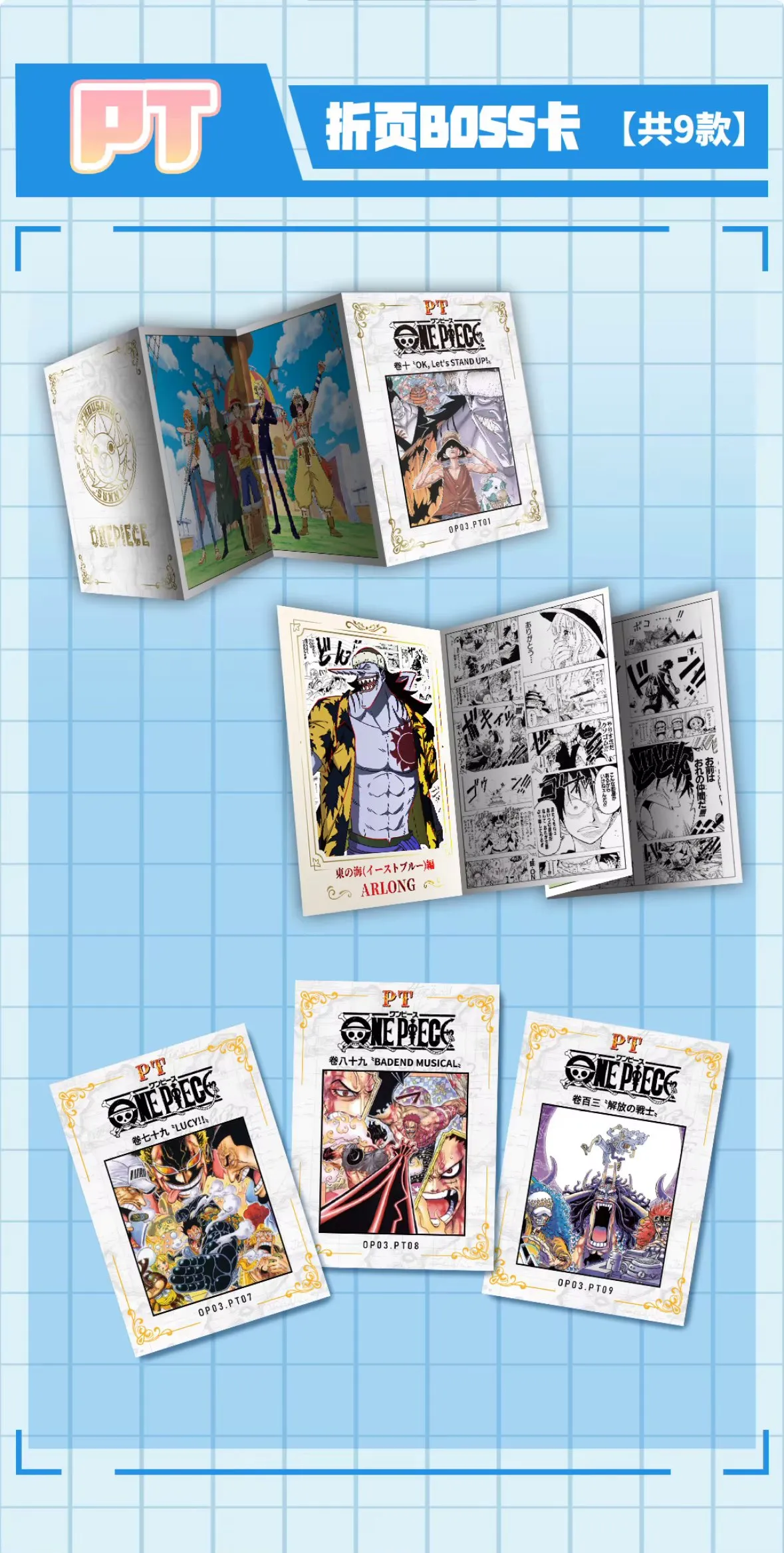
Those are foldout cards that open into booklets with real manga pages inside them. Nine designs. Alongside them: nine hand-drawn sketch cards, 3D lenticulars, gold medallion cards, graffiti-style art, oversized ticket cards. Now go read a write-up of the best One Piece TCG art of 2024 — it’s character portraits and parallel-art variants. Good ones! But that’s the format. A game card has to be a game card: same size, same layout, readable text box, tournament legal.
So there’s enormous, worldwide, provable demand for One Piece collectible cards, and the only entity permitted to make them has structurally decided not to and is blocking everyone else. That demand doesn’t evaporate because the paperwork doesn’t allow for it. It gets served by people who don’t ask. An exclusive that goes unused isn’t protection — it’s a vacuum, and the market fills vacuums.
Disney’s approach means dozens of licensed products and no bootlegs. One Piece’s approach means one licensed product and hundreds of bootlegs. I don’t think that’s a coincidence, and I don’t think it’s a Chinese problem. It’s a licensing problem that happens to get solved in China.
What Happens in Five Years
My viewer asked what I think happens next, and it took me a while to work out an answer I believe.
I think this market cleans itself up, mostly on its own, and I’d guess within five years. Not because anyone develops a conscience — because of a pattern China has run several times already. Clothing, cars, tools: heavily counterfeited domestically, then a handful of local companies got big enough to sell into Western markets, discovered they now had to respect IP abroad and were being undercut at home by people who didn’t, went back to their own government and pushed for a cleanup. Local market legitimizes. It’s happened over and over.
The trading card industry is at exactly that moment right now. Kayou, Card.Fun and Kabao are the three big legitimate publishers — all licensed-only operations. Kayou has nearly a hundred licenses including DC, Marvel and Harry Potter, and as of last year you can buy their cards in Target and Walmart. Card.Fun has Disney and Warner Bros. Kabao currently has Dragon Ball, which is not a small thing to be handed.
Once you’re competing globally against products that skip the licensing fee, you stop finding those products charming. These three have every reason to lean on Beijing about the print shops and on the export platforms that ship this stuff worldwide. And unlike Toei, they’re domestic companies with standing, relationships and no apostille problem. They can do in an afternoon what a Japanese rights holder can’t do in a year.
Which is the same lesson as the Disney one, one more time: enforcement in China is done by Chinese companies with money at stake. Everything else is theory.
And if Kayou or Card.Fun ever does land the One Piece license, every box on my table disappears overnight — because then there’d finally be a licensee with a reason to make the phone call. Kayou, if you’re reading this: I will negotiate that deal for you for free.
Why I Still Open This Stuff
Fair question, and I’d rather answer it than have it asked in the comments.
I show unlicensed product because for One Piece collectible cards it is the only product that exists. When there’s a licensed option I buy the licensed option — I’ve reviewed piles of Kayou sets on this site and I’d rather cover those. For this category, there is no licensed version to show you. So I show what exists, and I tell you plainly what it is, every single time.
The other half of my reasoning is about scale. Me buying a box does not move this market. The market is China; Western exports are a rounding error, and we’re getting these things second or third hand anyway. Whoever DMS really is made their money months ago. My $22 went to a reseller.
Is that a fully satisfying answer? No. It’s the honest one. If you’d rather I didn’t cover unlicensed sets at all, say so in the comments — I do read them, and this entire article exists because one of you pushed back on me.
Speaking of which: this set isn’t in my eBay store and I’m not making a cent from it. The AliExpress link below isn’t even an affiliate link — that listing doesn’t support the program. Given everything you just read, that feels about right.
The Box: One Piece DMS Vol. 3
Okay. Enough law. Let’s open the thing.
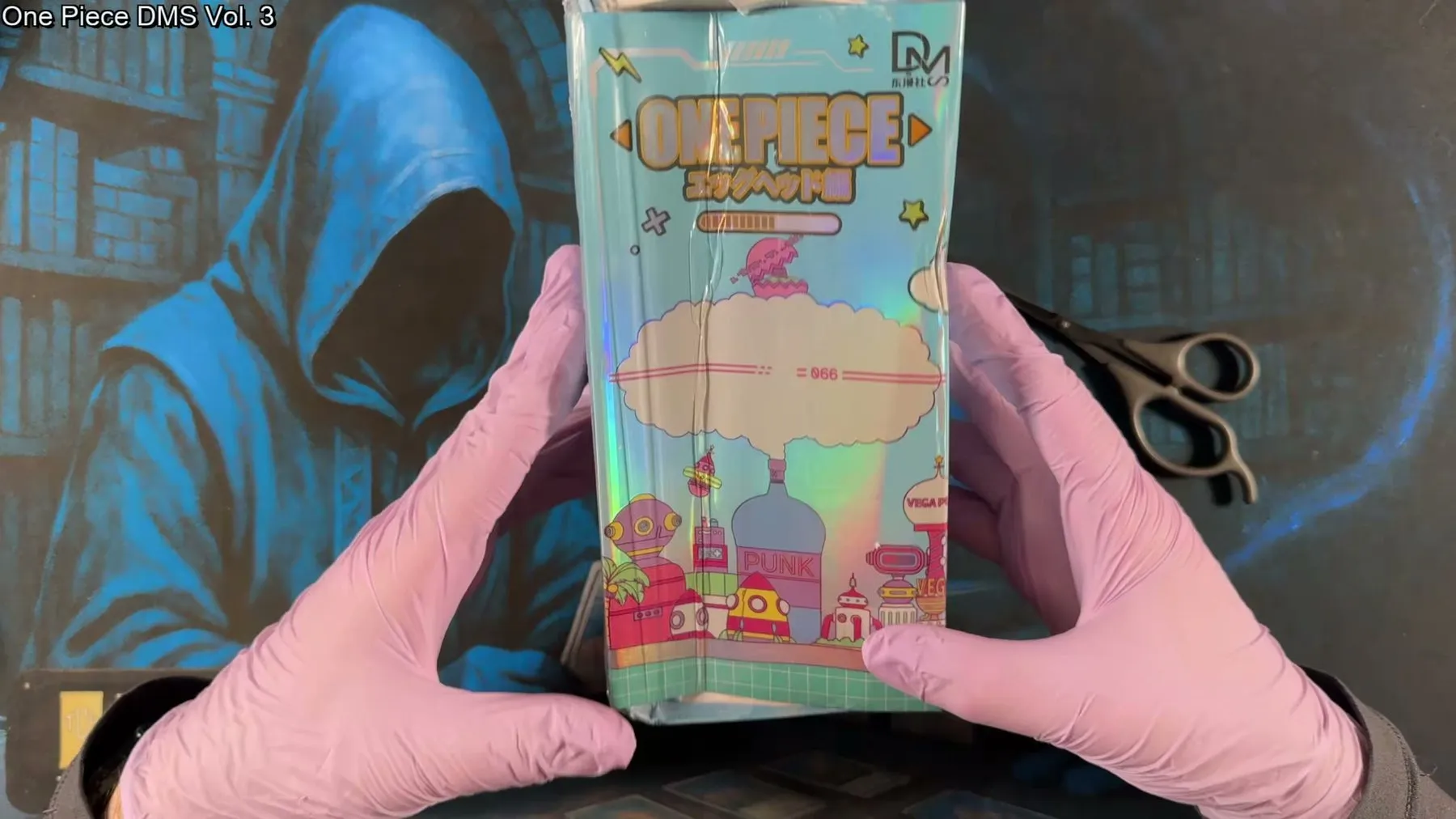
It arrived like that. Completely obliterated. The cards inside were fine, which tells you something about how these are packed, but the box itself took a beating somewhere between Guangdong and California.
This is DMS Vol. 3, 空白的历史 — “The Blank History,” the Egghead arc set. 东漫社 is the publisher.
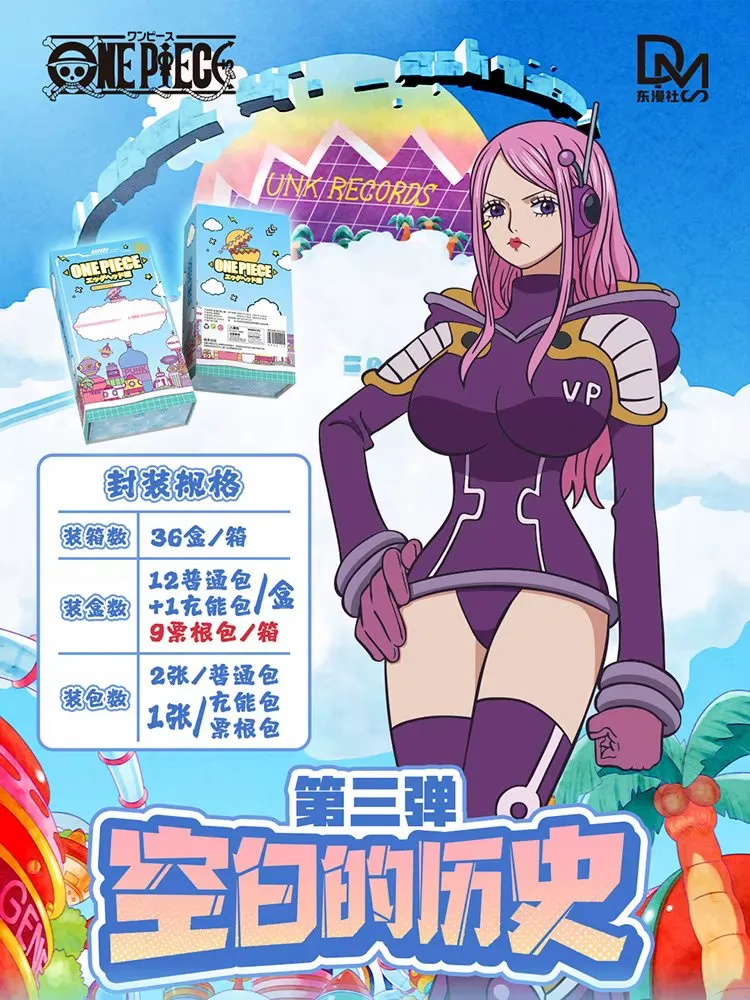
The configuration is 36 boxes to a case, and each box has 12 regular packs plus a bonus pack — 13 total, two cards in each regular pack. About $22 a box, or $38 for two, which is remarkable value for what’s in here.
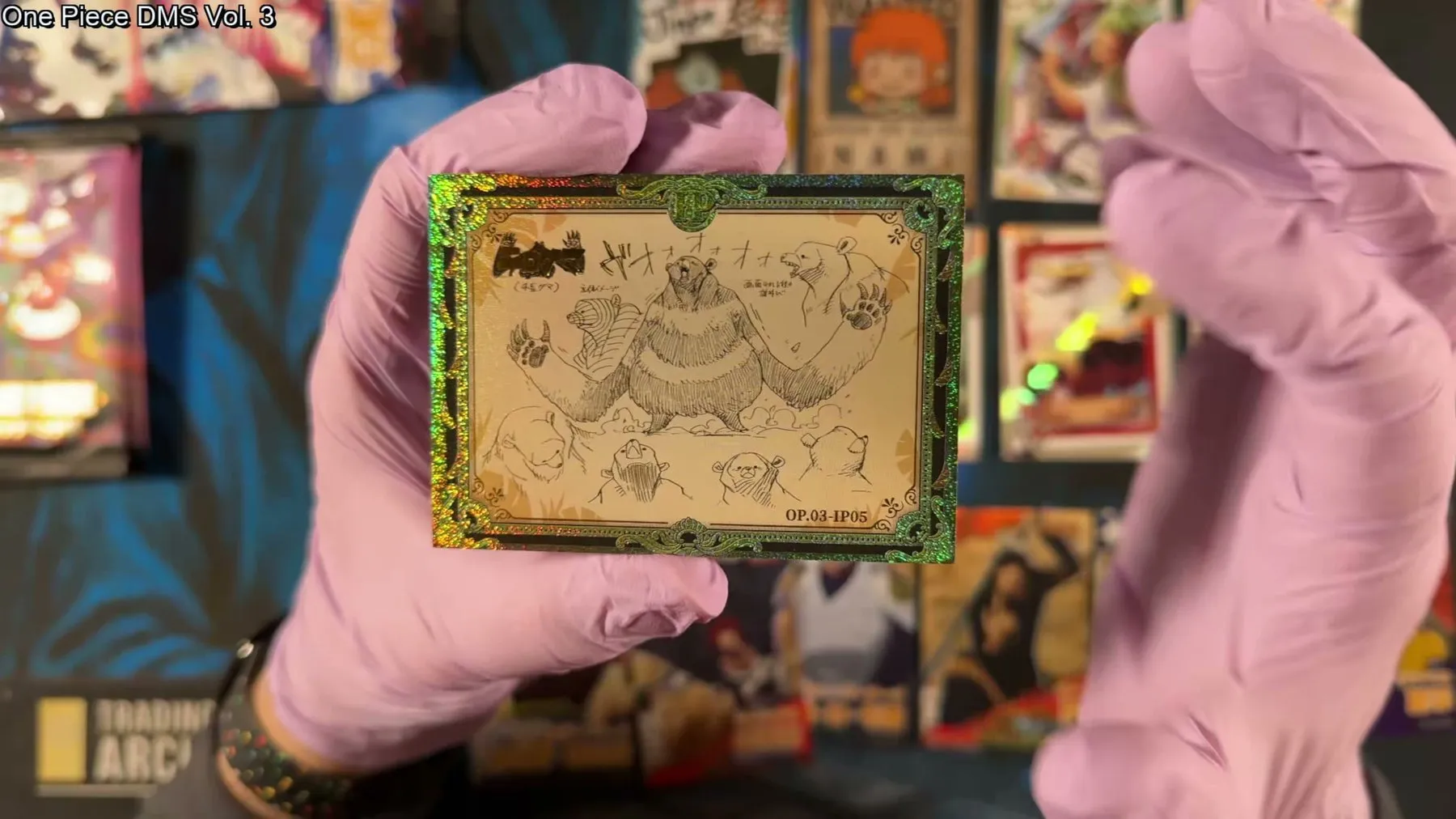
And this is the card of the box. OP.03-IP05, a gold-framed sketch card of Bartholomew Kuma — the actual design sketches, in a green-gold glitter border. It’s genuinely gorgeous and it’s worth the price of the box on its own. This is the format I keep talking about: nobody’s TCG makes this card.
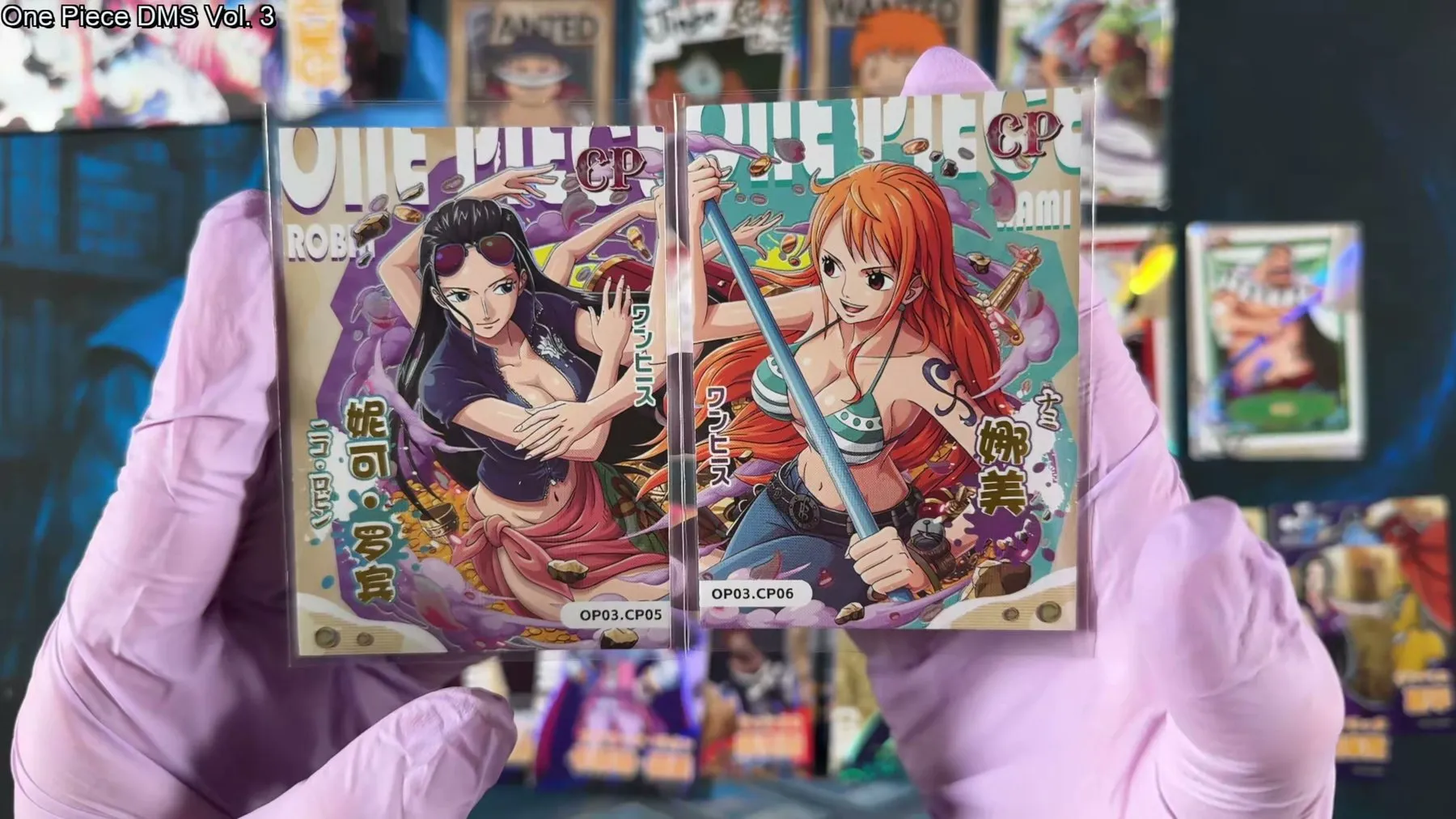
Then the actual payoff — OP03.CP05 Nico Robin and OP03.CP06 Nami, a matching CP pair whose artwork links across both cards into one image. Pulling both halves out of the same box is a lovely bit of luck.
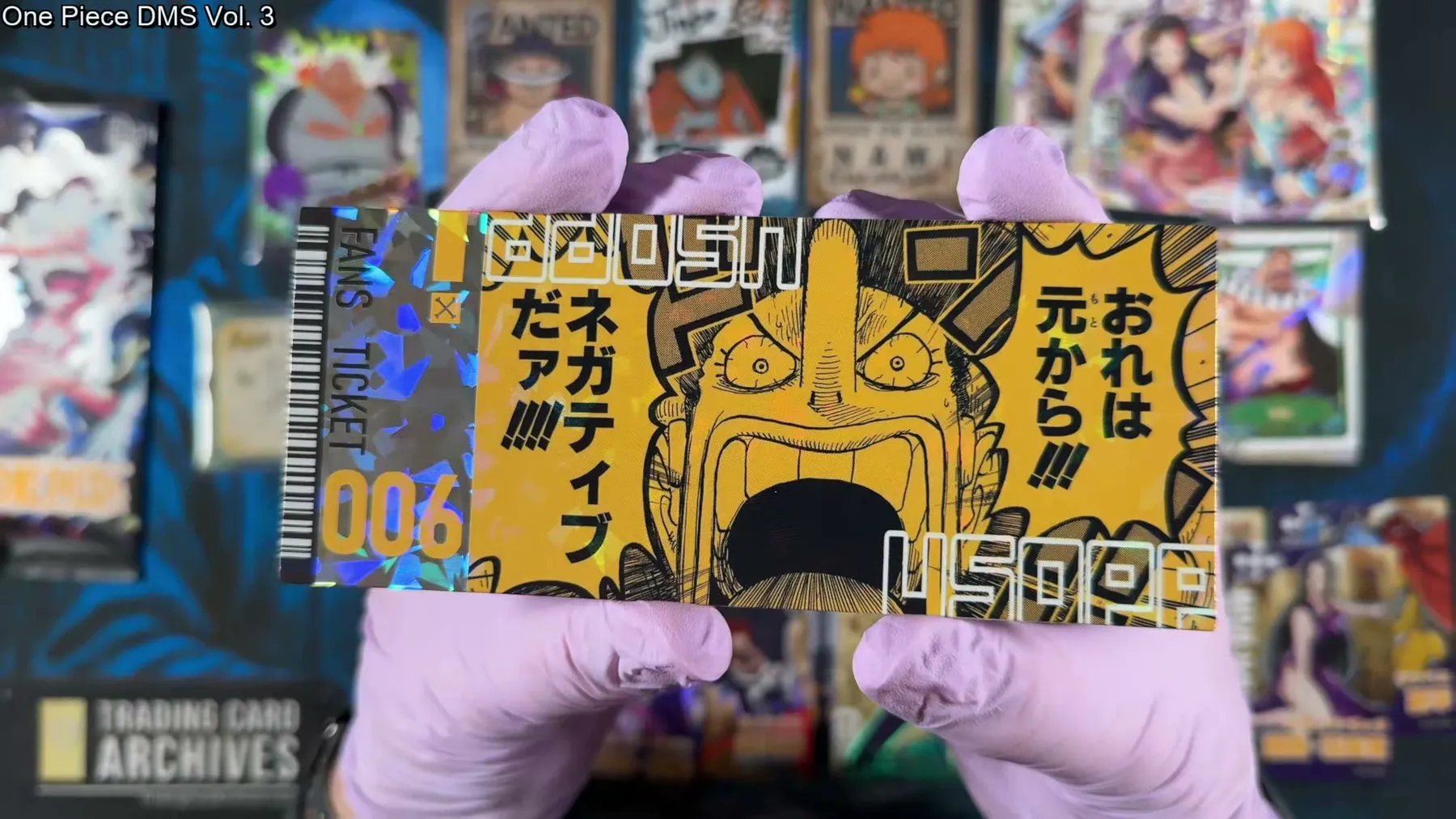
The oversized holo FANS TICKET 006 Usopp, mid-scream, in eye-searing yellow. Loud, silly and my favorite card in the box that isn’t the Kuma.
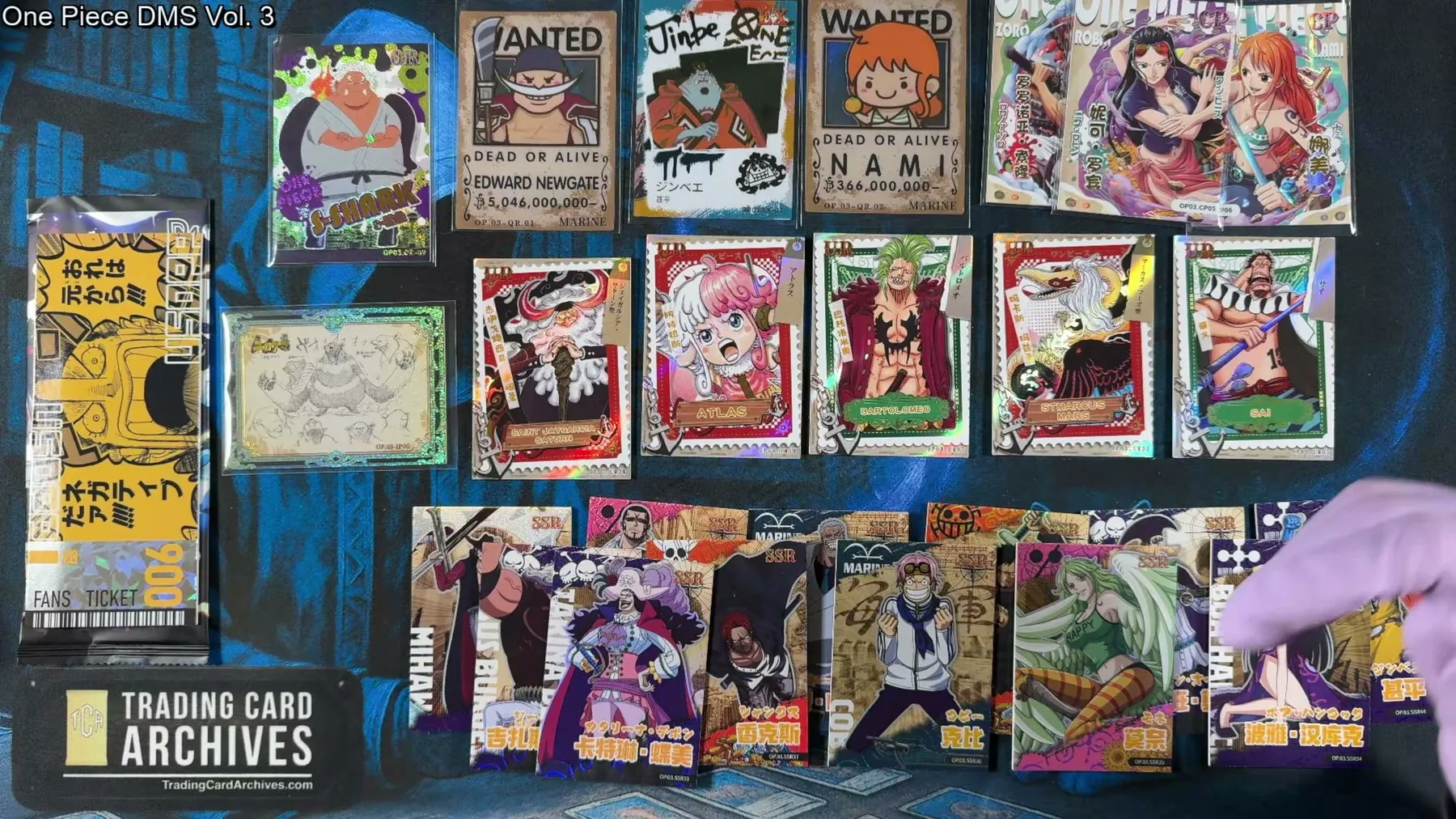
Here’s everything. URs of Saint Jaygarcia Saturn, Atlas, Bartolomeo, St. Marcus Mars and Sai; SSRs of Mihawk, Shanks, Boa Hancock, Coby, Catarina Devon and Jinbe; QR-code wanted posters including a Whitebeard at ฿5,046,000,000; the S-SHARK QR card; and the two chase cards above.
Conclusions
The print quality on this stuff is shockingly good. That’s not a compliment I’m entirely comfortable making, and it’s precisely why the whole problem exists — these aren’t crude fakes, they’re excellent products with a hole where the license should be.
So: is this set licensed? No. Now you also know how to tell, why nobody stops it, and why I think the fix isn’t tougher enforcement but a rights holder finally deciding to sell people the thing they obviously want to buy.
Tell me what you think in the comments — does this market clean itself up, or is doujin product permanent? I genuinely don’t know, and the last time someone argued with me about it I ended up writing all this.