Marvel Hero Rush Rules: How to Play Card Fun's Marvel TCG
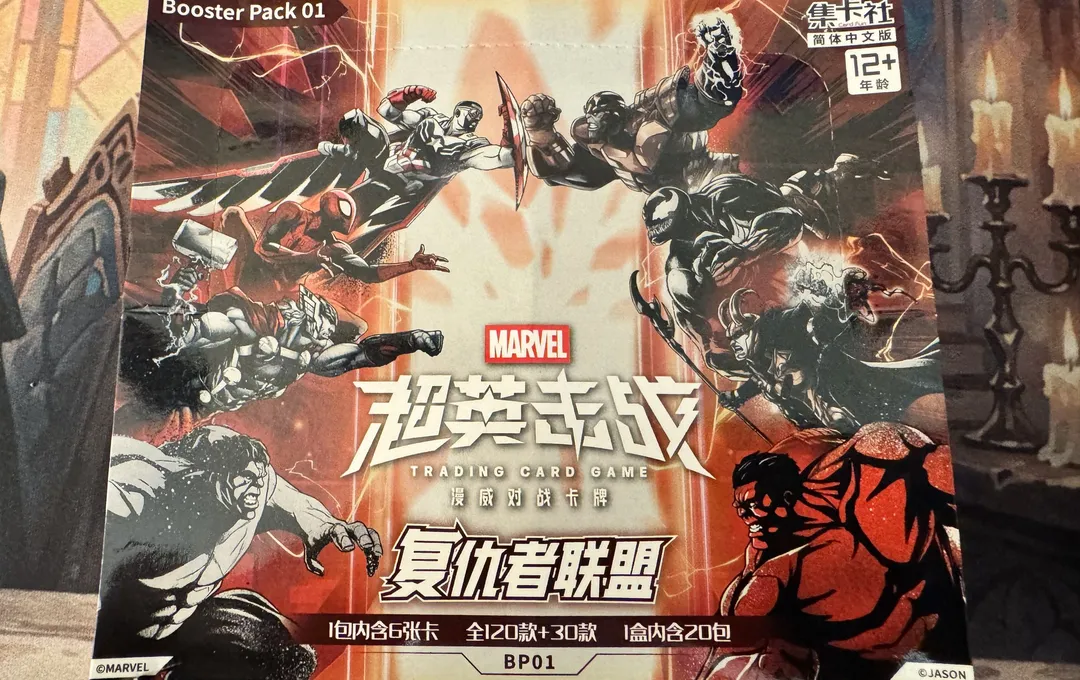
There is a brand new Marvel trading card game, it is very good, and unless you read Mandarin you have almost no way of knowing how to play it. Card Fun holds the Disney license in China, and Marvel Hero Rush — 超英击战 on every box, with 漫威对战卡牌 (“Marvel battle cards”) as the line name underneath — is the result: the first serious Marvel TCG since Kayou’s Marvel Hero Battle wound down. I bought the BP01 booster box and all four starter decks, and the starter decks come with a folded paper playmat and a two-sided quick-start rulebook, both entirely in Chinese.
So I did what I did for Hero Battle: I sat down with the mat and the rulebook and translated the whole thing. This post is not a box opening — it’s the rules. By the end of it you should be able to sit down across from someone with two starter decks and actually play a game.
- What you actually need to buy
- The playmat: nine zones
- How you win
- Building a deck
- Anatomy of a card
- Setting up a game
- A turn, phase by phase
- Combat: range, targets and openings
- Effect types and keywords
- Reading a real card
- How it compares to Hero Battle
- Conclusions
If you’d rather see the product in hand first, here’s the box and both starter decks getting opened:
What you actually need to buy
There are two products: the BP01 booster box and the SD01–SD04 starter decks.
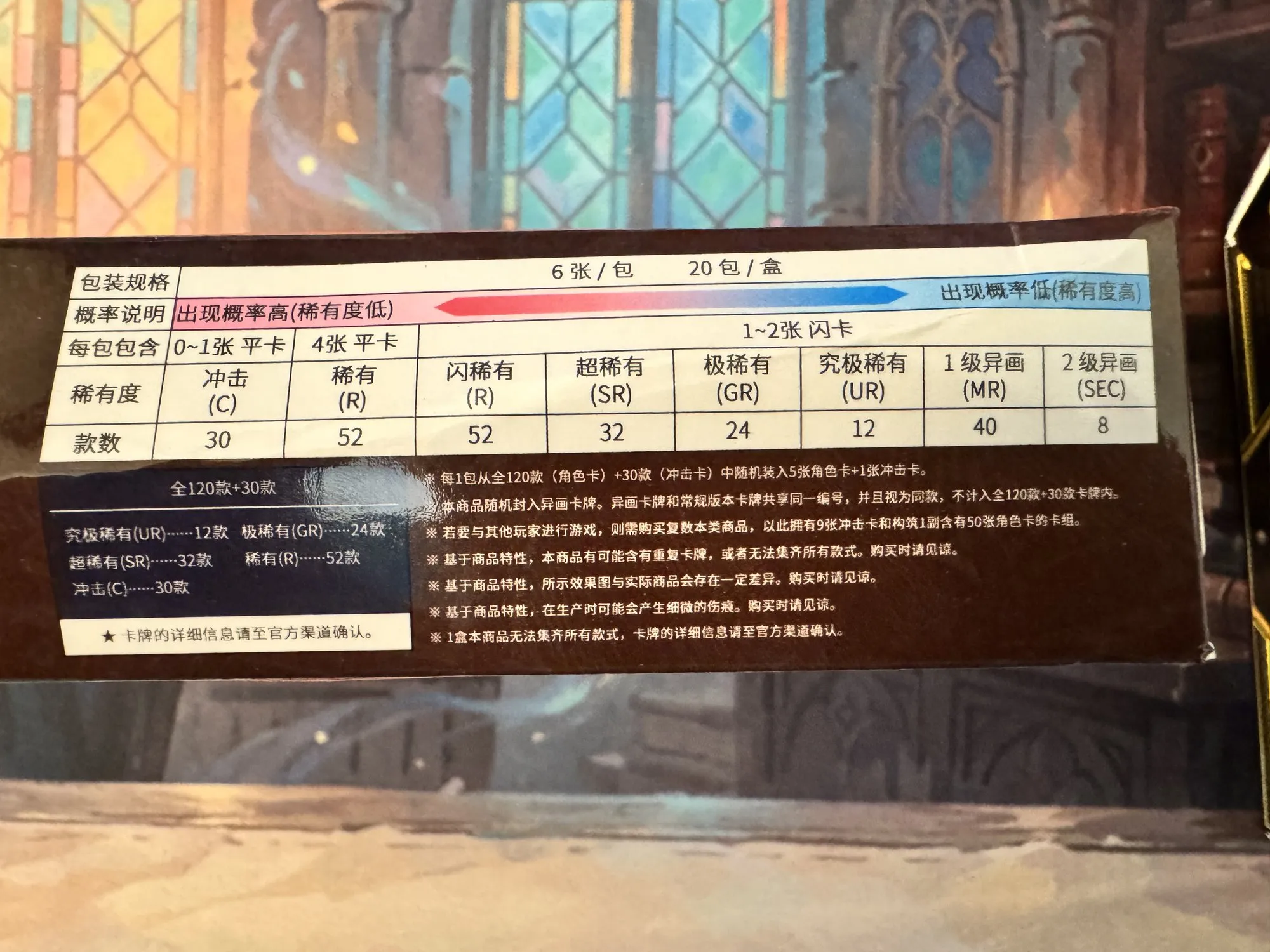
The box panel is the most information-dense thing in the whole product line, so here it is translated. 6 cards per pack, 20 packs per box. Every pack is 5 character cards (角色卡) plus 1 Rush Point card (冲击卡), and 1–2 of the six will be foil. The set is 120 character card designs + 30 Rush Point designs, split like this:
| Chinese | Rarity | Designs |
|---|---|---|
| 冲击 | C — the Rush Point cards | 30 |
| 稀有 | R | 52 |
| 闪稀有 | R (foil) | 52 |
| 超稀有 | SR | 32 |
| 极稀有 | GR | 24 |
| 究极稀有 | UR | 12 |
| 1级异画 | MR (alternate art, tier 1) | 40 |
| 2级异画 | SEC (alternate art, tier 2) | 8 |
The 异画 tiers are worth understanding because they’re unusual: MR and SEC are alternate artwork of cards that already exist. The fine print says they share the same card number as the regular version, count as the same card for deck building, and are not counted inside the 120+30. So the chase cards in this game are not new characters, they’re the same characters redrawn. The R foils are likewise the same 52 R’s with shine on them.
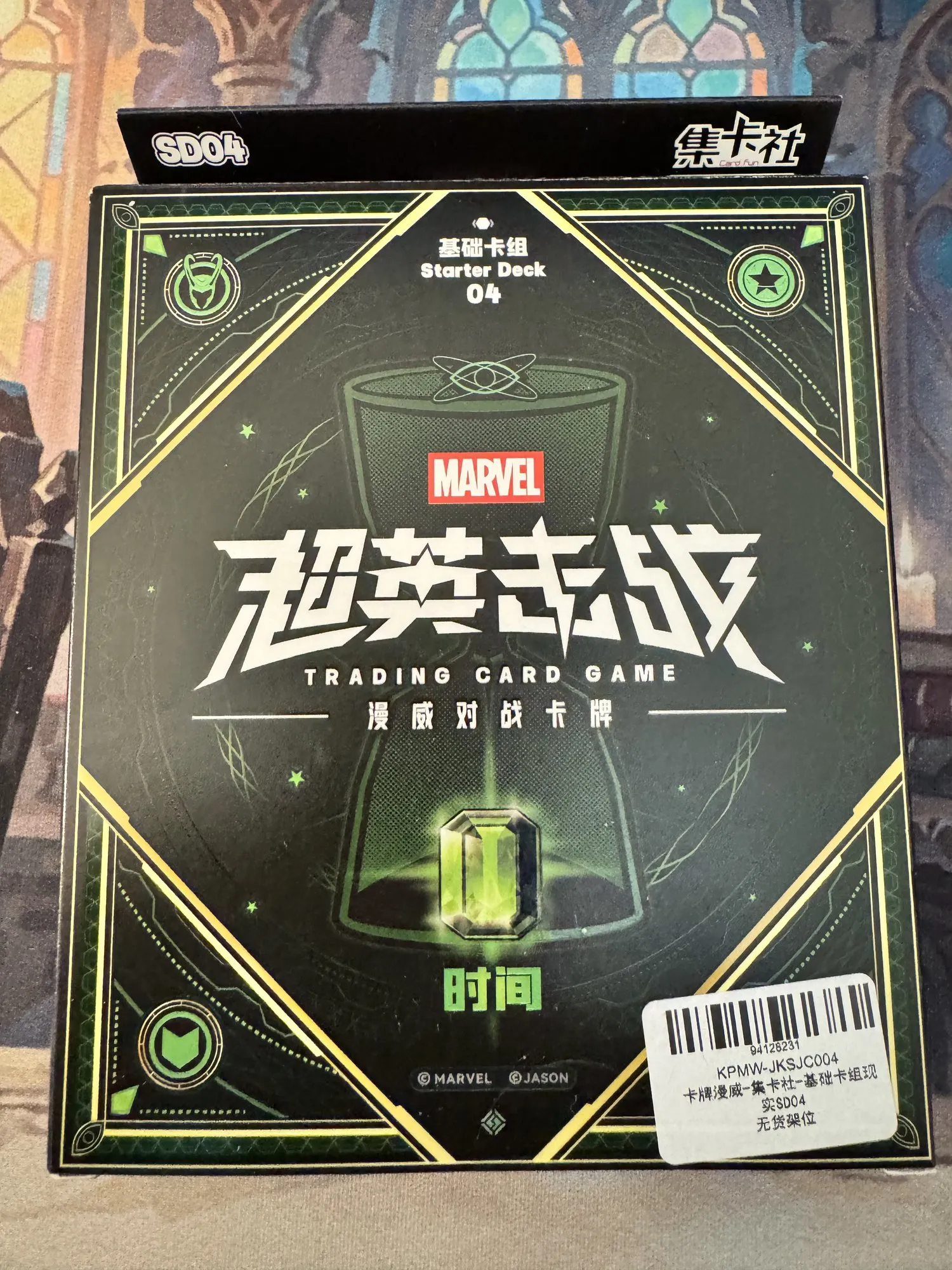
The starter decks are the ones you want if you intend to play. There are four, each themed to an Infinity Stone, and each is a fixed, legal, ready-to-shuffle deck. This is SD04, 时间 — Time, in green, built around Loki.
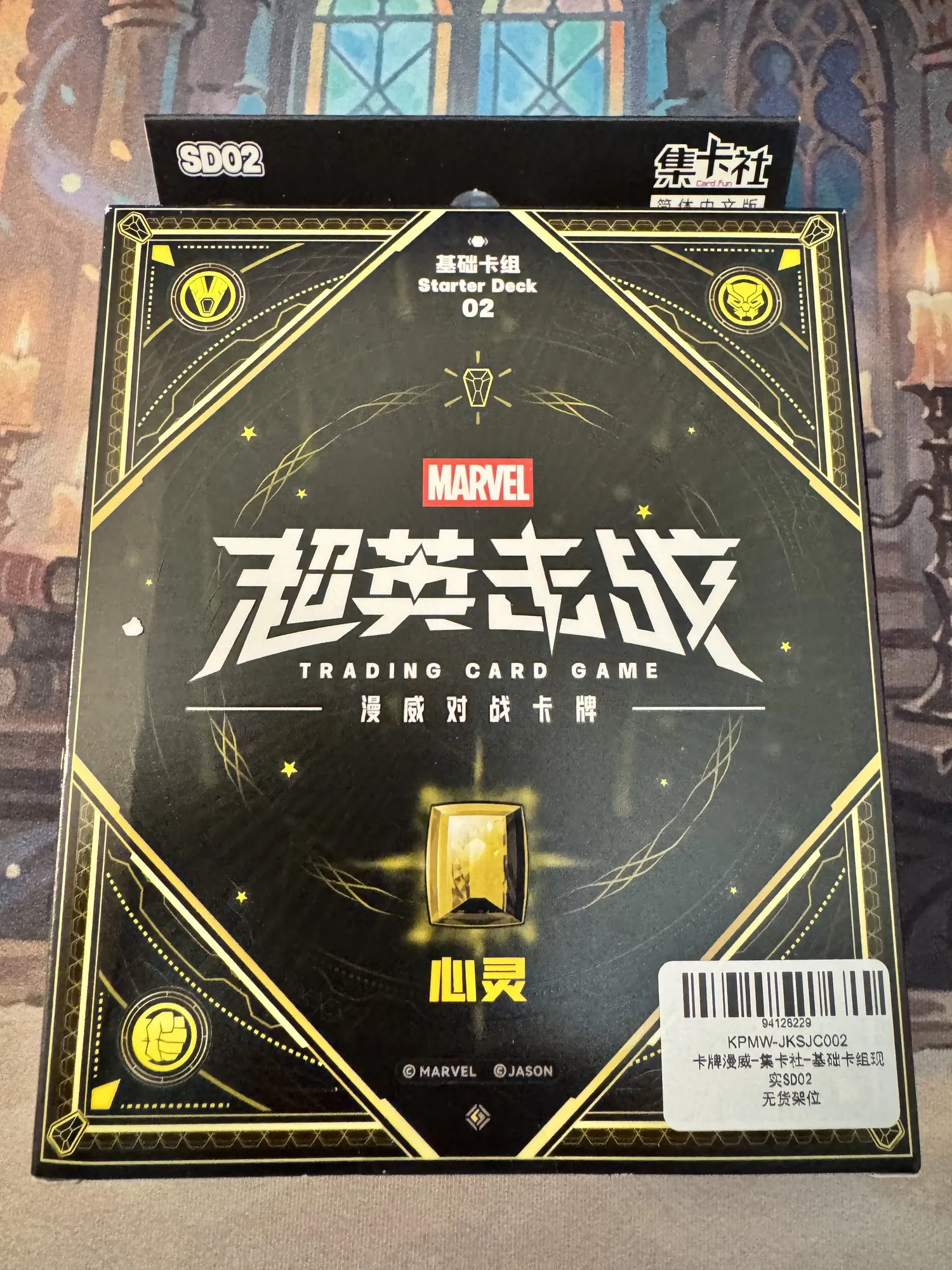
And SD02, 心灵 — Mind, in gold, built around Vision. The other two are Reality and Space, fronted by Iron Man and Captain America.
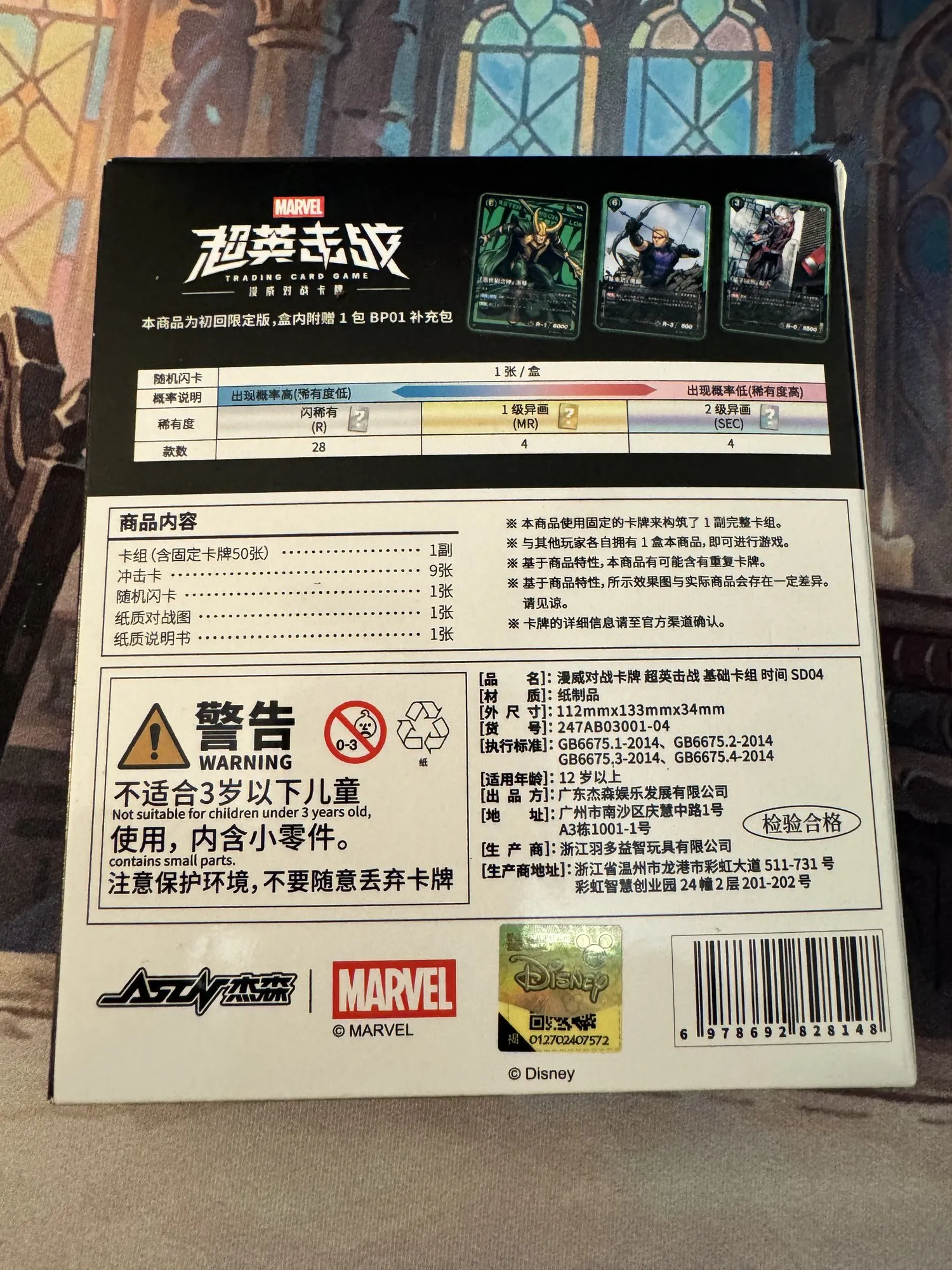
The contents list (商品内容) on the back is the important part:
- 卡组 — a deck of 50 fixed character cards × 1
- 冲击卡 — 9 Rush Point cards
- 随机闪卡 — 1 random foil card
- 纸质对战图 — 1 paper playmat
- 纸质说明书 — 1 paper rulebook
And in a red banner across the top: 本商品为初回限定版,盒内附赠1包BP01补充包 — “first-print limited edition, includes 1 BP01 booster pack.” That random foil pulls from 28 R foils, 4 MR and 4 SEC, at one per box — and it is a real lottery ticket, not a throwaway. Mine came out of the bottom of a starter deck as a full-art MR Loki, which I couldn’t read the rarity on at the time and have since taken apart line by line as the worked example at the end of this post.
Add it up and the starter deck is the only product that gets you playing on its own. It hands you a legal 50-card deck, a legal 9-card Rush Deck, the mat and the rules for the price of about two boosters. A booster box gets you 100 character cards and 20 Rush Points — enough raw material for a deck, but no mat, no rulebook, and no guarantee your 100 cards make a coherent 50. Buy two starter decks, play with a friend, and then buy boxes.
The playmat: nine zones
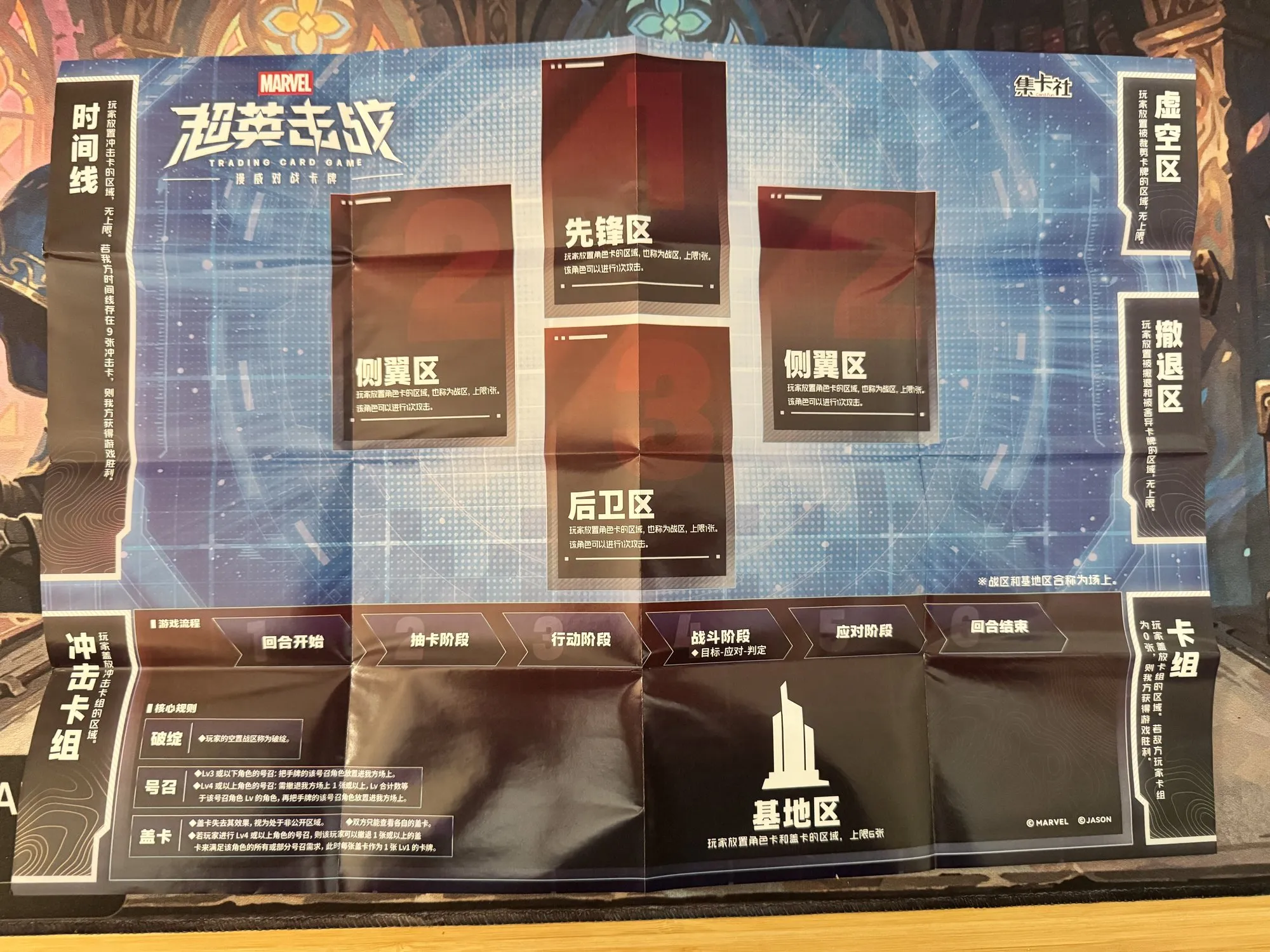
Here’s the whole mat unfolded. Like every good TCG, the layout is the rules — if you know where each pile lives you’re most of the way to understanding the game. Nine numbered areas:
- 先锋区 Vanguard Zone — holds 1 character. A Battle Zone.
- 侧翼区 Flank Zones — two of them, left and right, 1 character each. Battle Zones.
- 后卫区 Rearguard Zone — holds 1 character. A Battle Zone.
- 基地区 Base Zone — character cards and face-down cards, limit 6.
- 撤退区 Retreat Zone — retreated and discarded cards, no limit. Your graveyard.
- 虚空区 Void Zone — “trimmed” cards, no limit. Your exile.
- 时间线 Timeline — where Rush Point cards go, no limit. Your scoreboard.
- 卡组 Deck
- 冲击卡组 Rush Deck — your 9 Rush Points, face down.
One line on the mat matters more than it looks: ※战区和基地区合称为场上 — “the Battle Zones and the Base Zone together are called the field.” Card effects constantly say 场上 (on the field), and that means all five of those spots, not just the fighting ones.
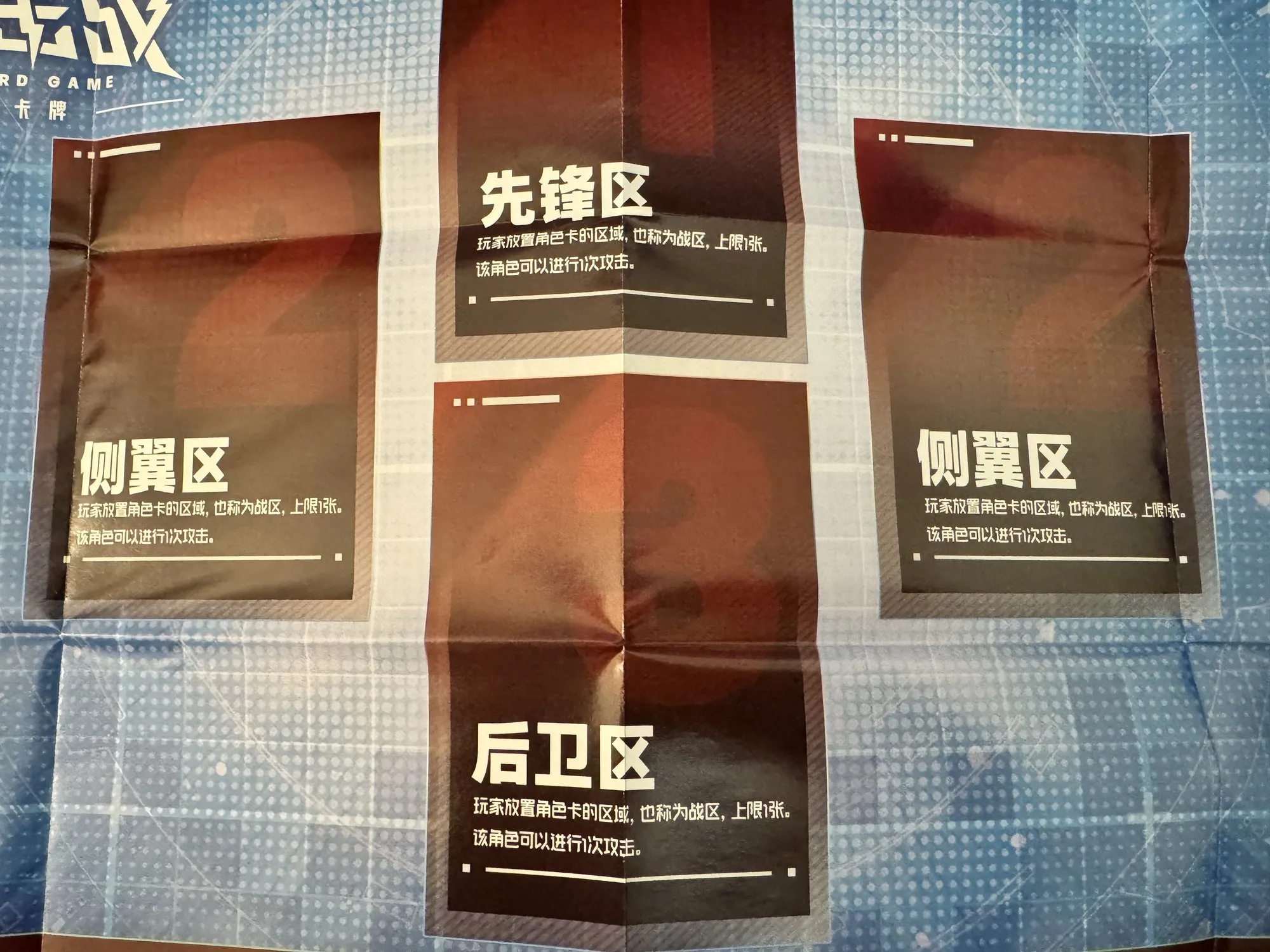
So you have exactly four fighting slots in a diamond — Vanguard at the front, a Flank on each side, Rearguard at the back — and a six-slot Base behind them. Every one of those four zones reads the same: 玩家放置角色卡的区域,也称为战区,上限1张。该角色可以进行1次攻击。 “The area where the player places a character card, also called a Battle Zone, limit 1. That character may make 1 attack.”
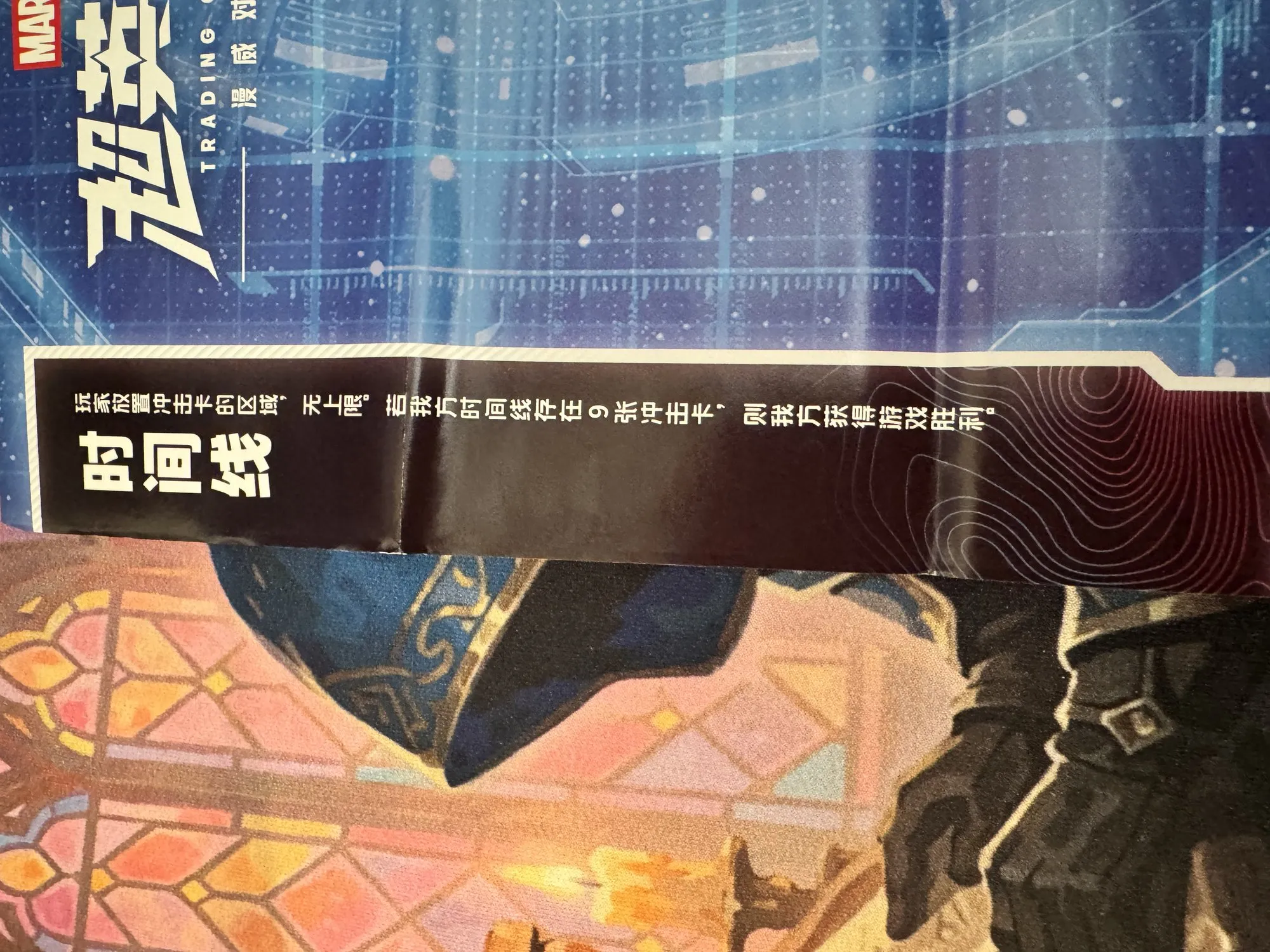
And the Timeline, which is the whole game: 玩家放置冲击卡的区域,无上限。若我方时间线存在9张冲击卡,则我方获得游戏胜利。 “The area where the player places Rush Point cards, no limit. If your Timeline holds 9 Rush Point cards, you win the game.”
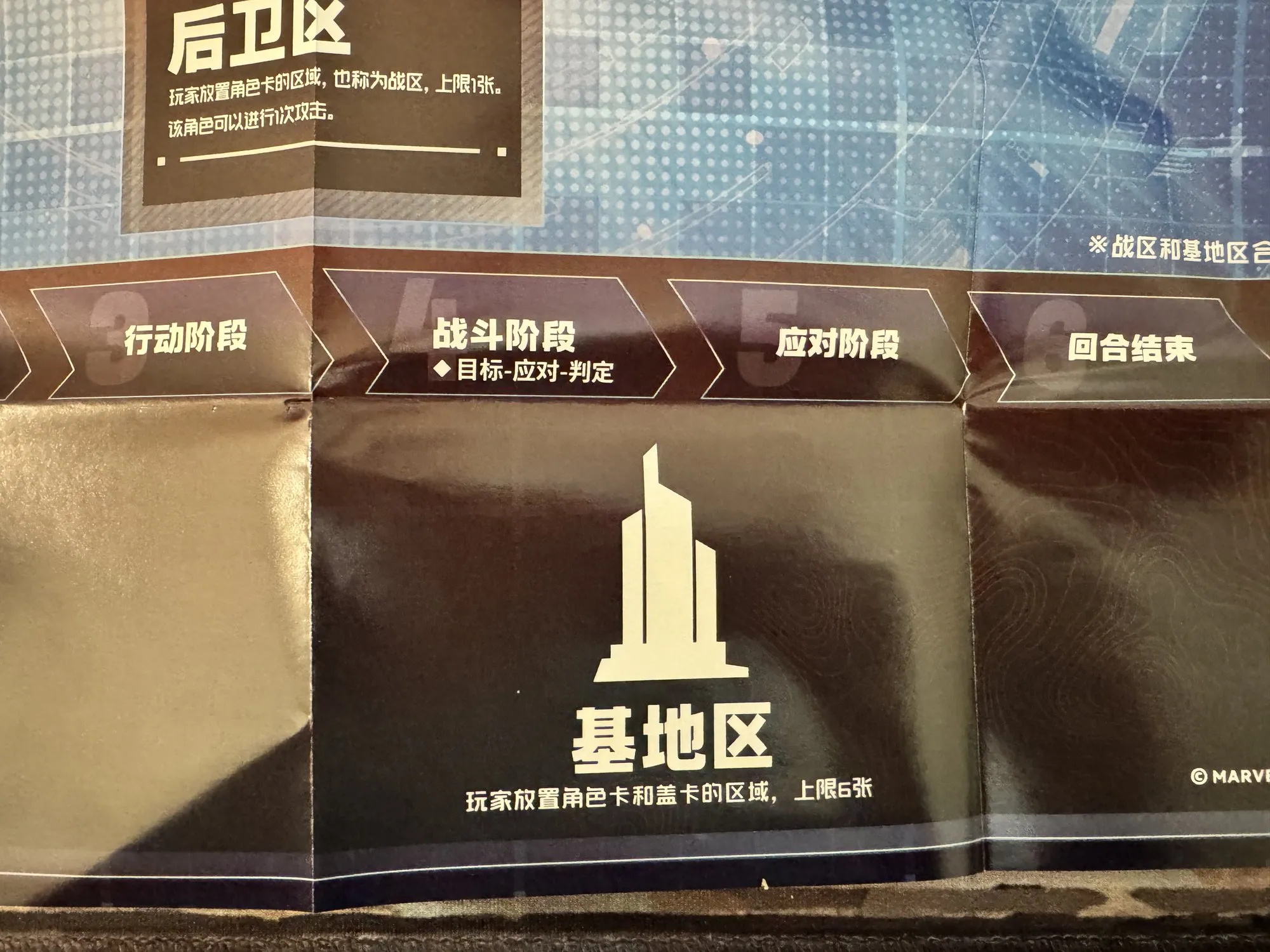
The Base Zone: 玩家放置角色卡和盖卡的区域,上限6张 — character cards and set cards, limit 6. That’s your bench and your resource pile in one, and we’ll come back to why in the Action Phase.
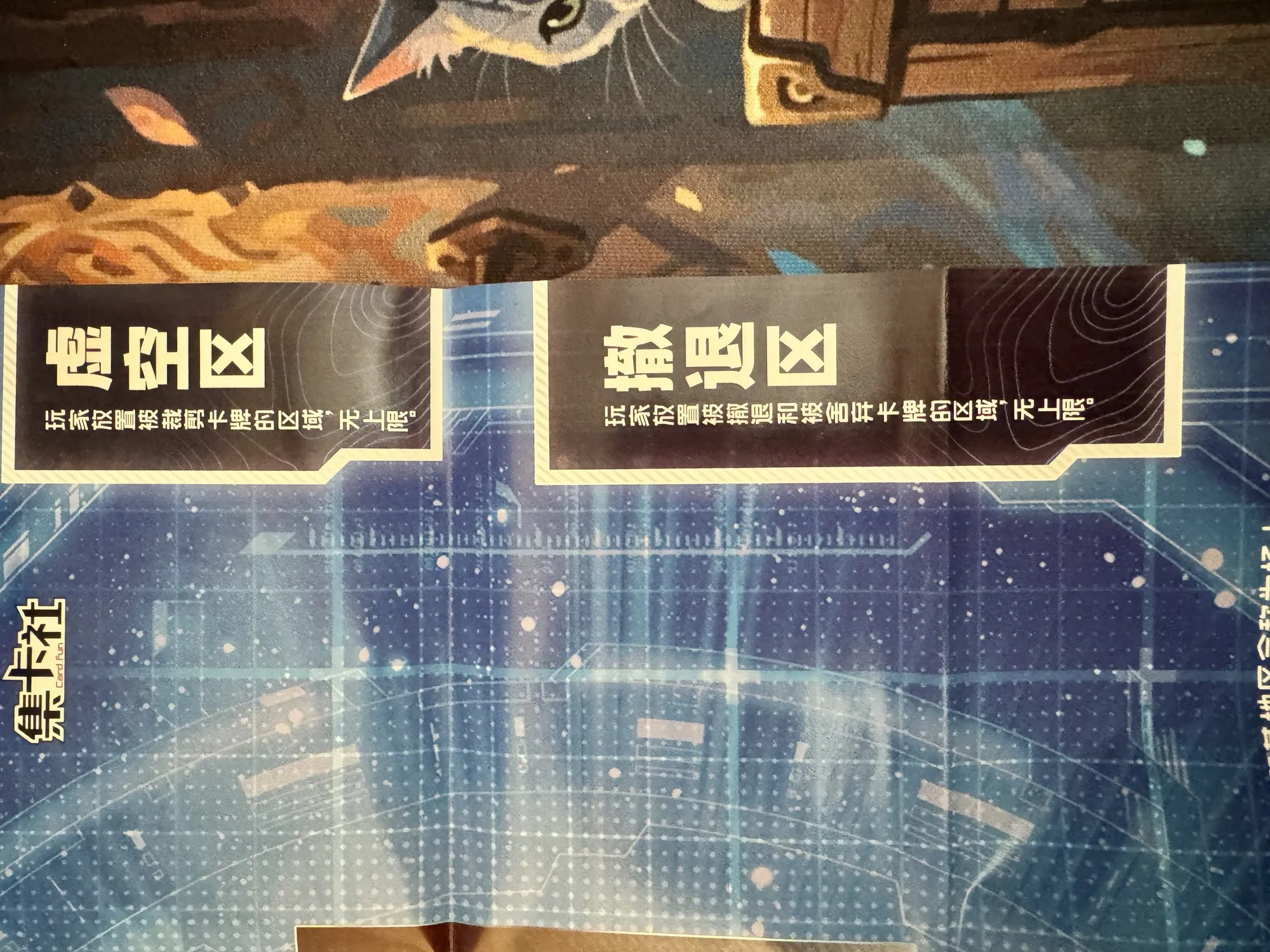
The two dead-card zones are worth separating in your head, because the game uses different verbs for them. 撤退 (retreat) sends a card to the Retreat Zone, and that’s normal — a character that loses a fight retreats, and effects can pull cards back out. 裁剪 (trim) sends a card to the Void Zone, and that’s gone for good. If a card says 裁剪, treat it like exile in Magic.
How you win
There are two win conditions, and only two:
- 我方时间线存在9张冲击卡 — you have 9 Rush Points in your Timeline.
- 敌方卡组为0张 — the opponent’s deck is empty.
You get a Rush Point exactly one way in the base rules: you attack a 破绽 — an Opening — and connect. And 破绽 has a beautifully simple definition on the mat: 玩家的空置战区称为破绽 — “a player’s empty Battle Zone is called an Opening.”
That’s the entire game in one sentence. Your opponent has four Battle Zones. Any of them that is empty is a hole in their line. If one of your characters can reach that hole, you swing at it, nobody blocks, and the top card of your Rush Deck flips onto your Timeline. Nine of those and you’ve won.
Which reframes everything. Combat isn’t about killing characters — it’s about making holes and then walking through them. Killing a defender is only good because a dead defender leaves an empty zone behind for next turn. That’s a genuinely clever piece of design and it’s why the game plays nothing like Hero Battle despite looking similar on the shelf.
The deck-out condition is real, by the way, not decoration: you draw two cards every turn out of a 50-card deck. Games have a hard clock of about 25 turns.
Building a deck
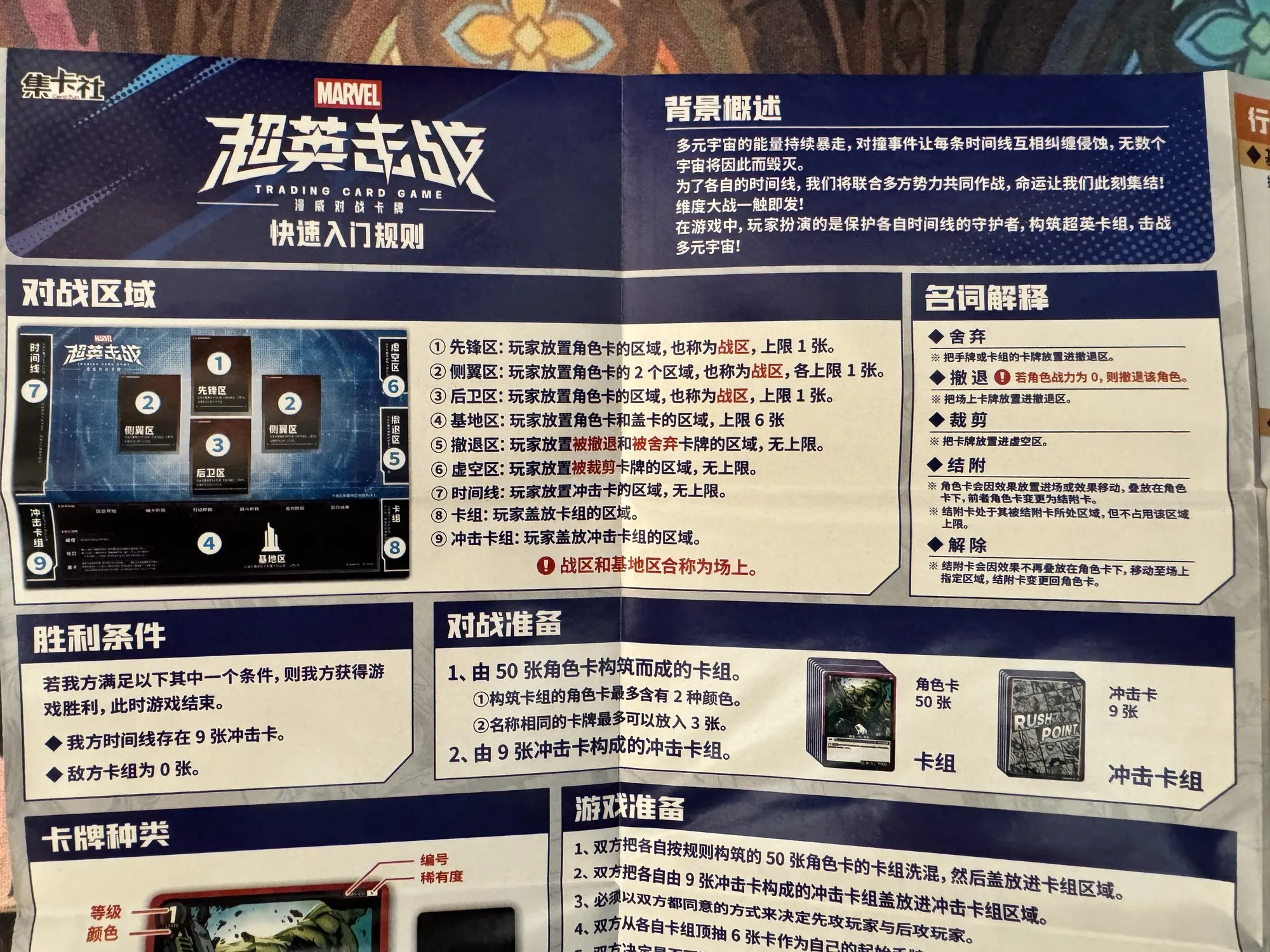
Deck construction (对战准备) is short:
- A deck of 50 character cards.
- The character cards in your deck may contain at most 2 colors.
- At most 3 copies of any one card name.
- A Rush Deck of exactly 9 Rush Point cards.
That’s it. No rarity restrictions, no level curve requirements, no side deck in the quick-start rules. The two-color limit is the interesting constraint — colors are the Infinity Stone colors the starter decks are built around, and card effects reference them directly (the sample Hulk in the rulebook does something with “a red character in your Retreat Zone”). So a deck is a two-stone identity, and the starter decks are single-stone training wheels.
Nine Rush Points is a fixed number for everybody. They aren’t drawn, played, or shuffled into anything — they sit face down in their own pile and get promoted to the Timeline one at a time as you score. The rulebook’s own description is nice: 代表玩家胜利的步伐,不进入卡组的构筑 — “they represent the player’s steps toward victory, and are not part of deck construction.”
Anatomy of a card
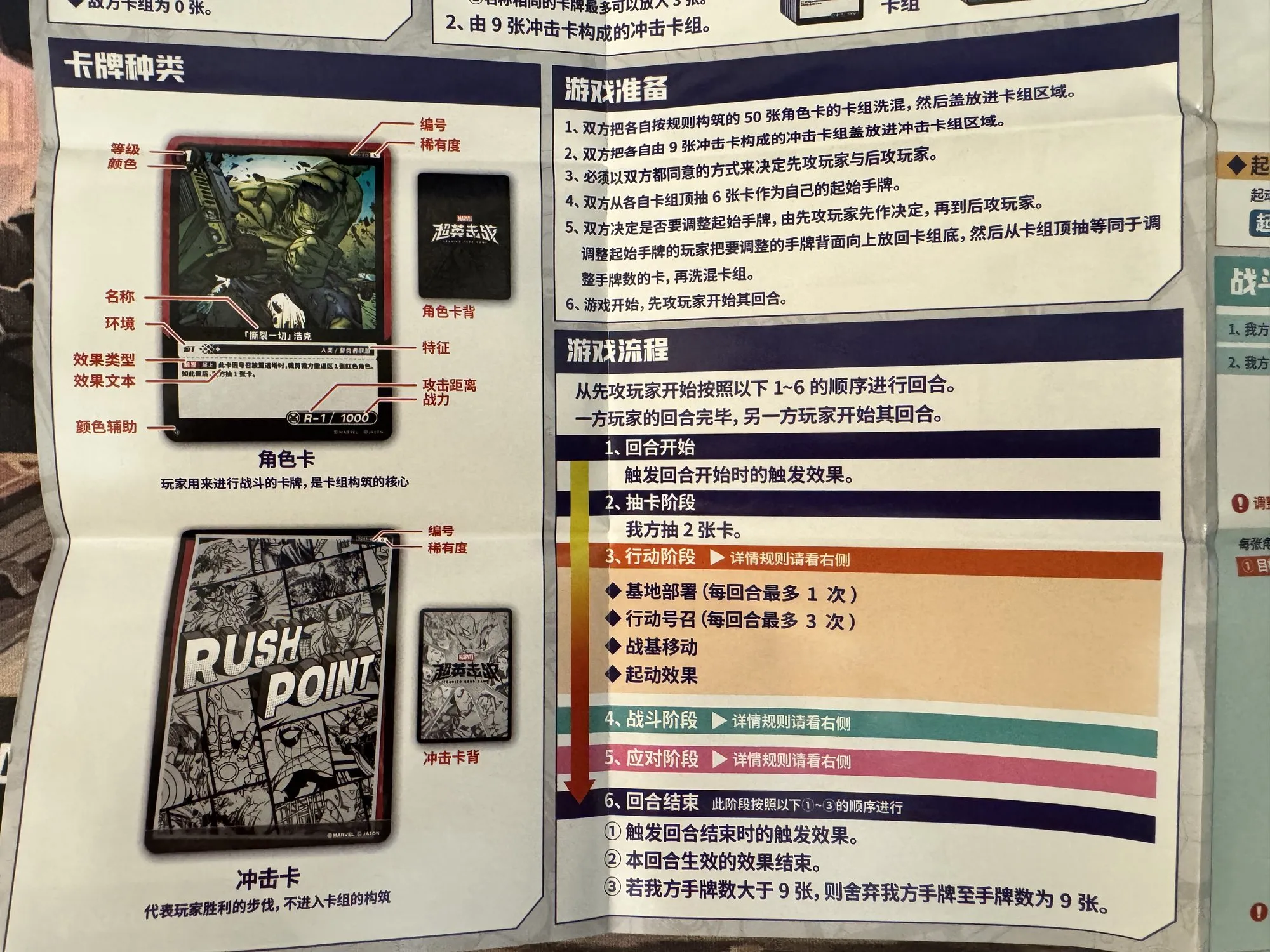
The rulebook labels a character card (角色卡) field by field. Clockwise from the top-left corner:
- 等级 Level — the number in the top-left corner. This is the closest thing the game has to a mana cost, and it works through the summoning rules rather than through a resource pool.
- 颜色 Color — the gem marker under the level. There’s also a 颜色辅助 (colour assist) dot in the bottom-left corner, a small colourblind-accessibility touch I appreciate.
- 编号 Number and 稀有度 Rarity — top right.
- 名称 Name — under the art. (This one is 「撕裂一切」浩克, roughly “Tear Everything Apart” Hulk.)
- 环境 Environment and 特征 Traits — the thin black strip below the name. Traits are on the right, comma-separated: this Hulk is 人类/复仇者联盟, Human / Avengers. Traits are what card effects key off, so these matter and you will be translating them.
- 效果类型 Effect type and 效果文本 Effect text — the coloured tag at the start of each ability, then the ability itself.
- 攻击距离 Attack range and 战力 Power — the bottom bar, printed as
R-1 / 1000. R is range, 1000 is power.
Two numbers do all the work in combat: R (how far the character can reach) and 战力 (how hard it hits). There is no separate defence stat — power is compared against power.
Setting up a game
Straight from the rulebook (游戏准备):
- Both players shuffle their 50-card character deck and place it face down in the Deck zone.
- Both place their 9-card Rush Deck face down in the Rush Deck zone.
- Decide who goes first by any method both players agree to (the book genuinely just says this).
- Both draw 6 cards from the top of their deck as an opening hand.
- Both decide whether to mulligan, first player deciding first. To mulligan, put the cards you’re changing face down on the bottom of your deck, draw that many from the top, then shuffle.
- The first player begins their turn.
That mulligan is unusually generous — you’re not down a card, you’re just swapping. Take it.
A turn, phase by phase
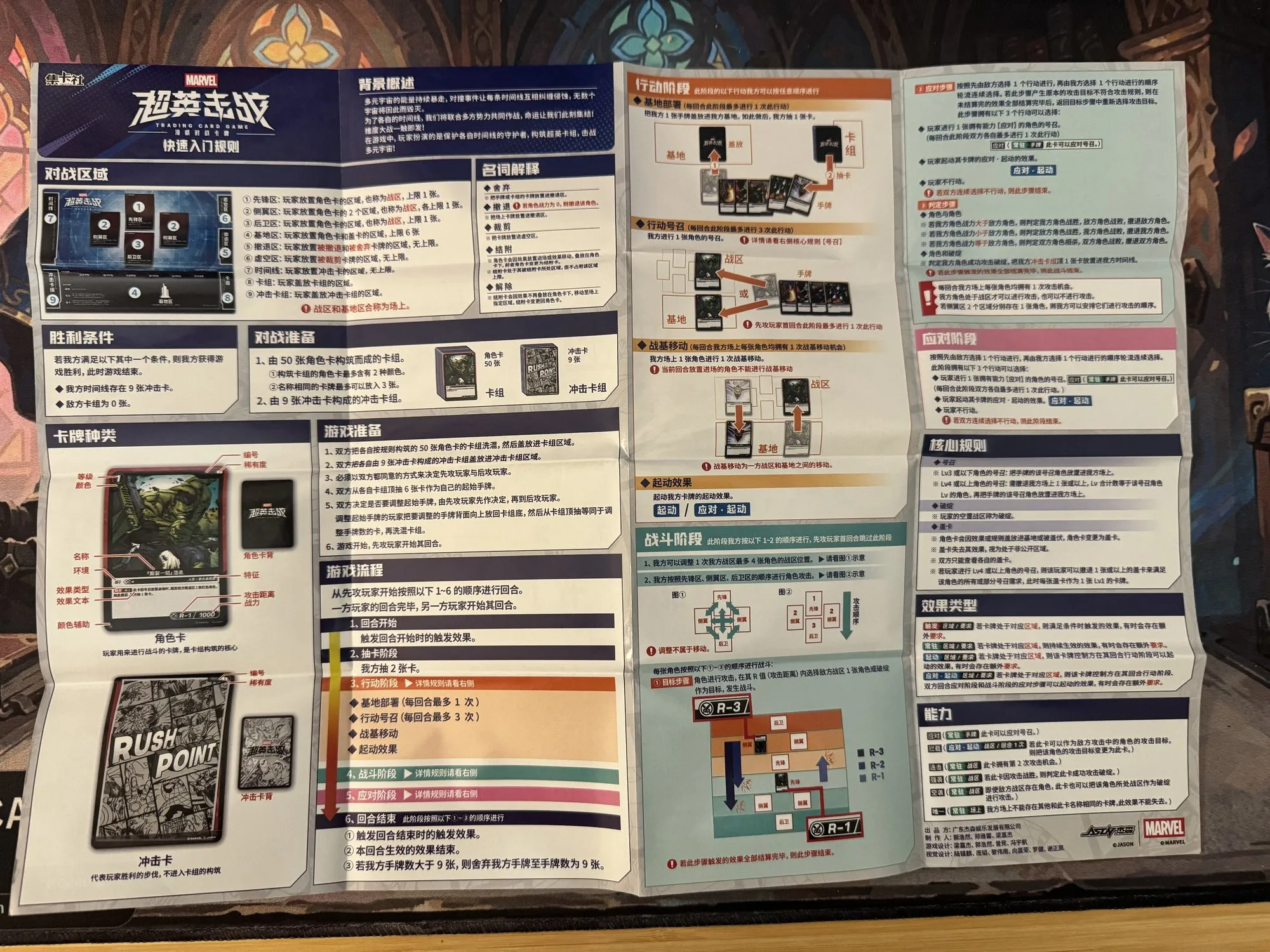
Six steps, in order, and then the other player does the same.
1. 回合开始 Turn Start. Resolve any “at the start of the turn” triggers.
2. 抽卡阶段 Draw Phase. Draw 2 cards. Yes, two. That is a lot of gas, and it’s why the deck-out clock is real.
3. 行动阶段 Action Phase. The meat. You may take the following actions in any order you like:
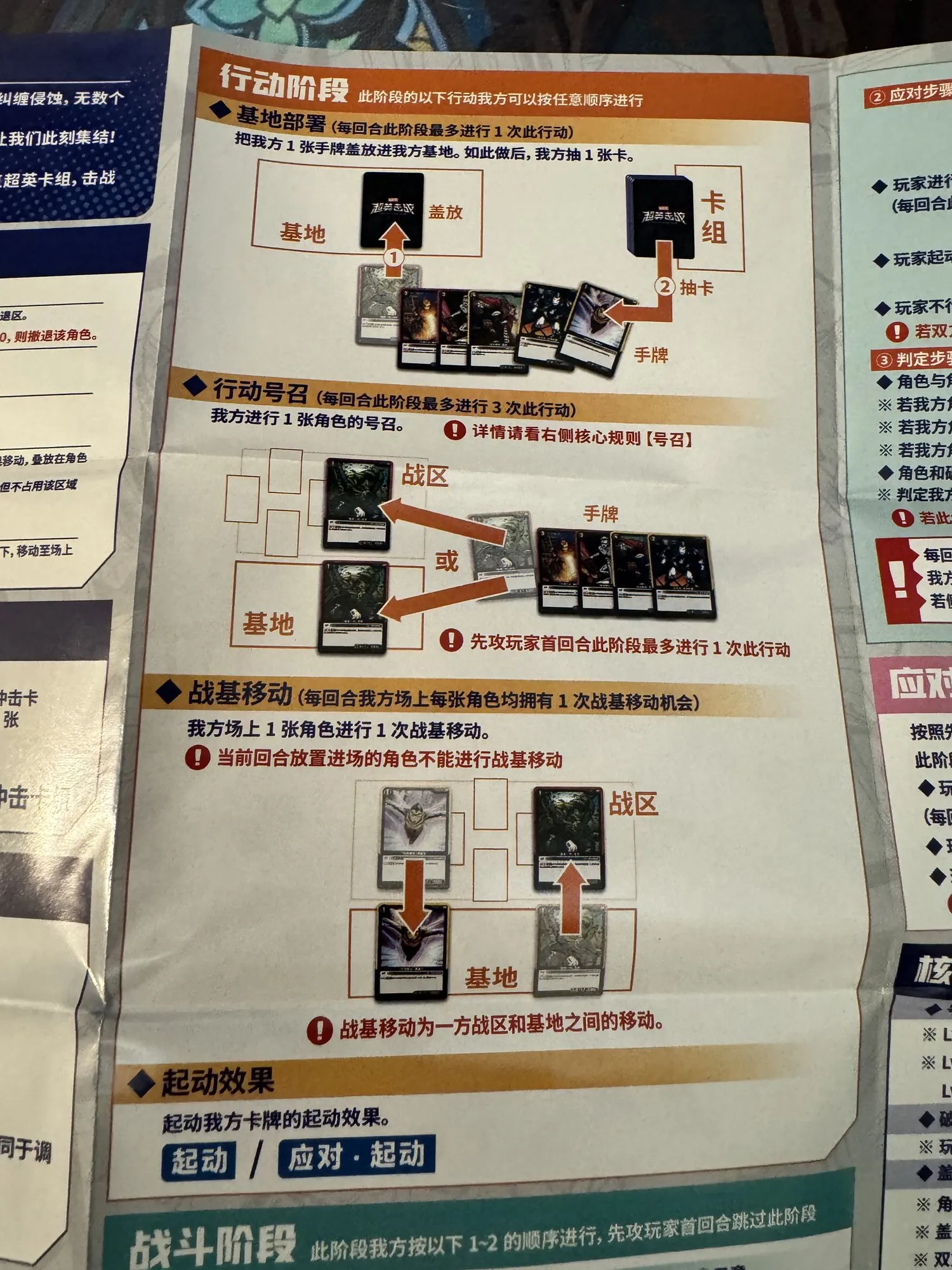
- 基地部署 Base Deployment (max 1× per turn) — put 1 card from your hand face down into your Base Zone. After doing so, draw 1 card. This is the closest thing to a land drop: you’re converting a card in hand into a face-down body in the Base, and you get replaced for free. Set cards lose all their effects and count as hidden information — only you may look at your own.
- 行动号召 Summon (max 3× per turn; the first player gets only 1 on their first turn) — put a character from your hand onto the field, into either a Battle Zone or the Base.
- 战基移动 Battle/Base Movement (each character on your field gets 1 per turn) — move a character between your Battle Zones and your Base. A character placed on the field this turn cannot move.
- 起动效果 Activate — activate any 起动 abilities on your cards.
The summoning rule (号召) is where Level pays off, and it’s genuinely elegant:
- Level 3 or lower: just put it on the field. Free.
- Level 4 or higher: you must first retreat one or more of your own characters whose Levels add up to exactly the summoned character’s Level, then put it down.
So there’s no mana. Big characters are paid for in bodies. A Level 5 costs you a Level 5, or a 3 and a 2, or five Level 1s — and every one of those bodies was holding a Battle Zone shut. Deploying your bomb opens holes in your own line on the same turn. That is a wonderful tension and it’s the best rule in the game.
The escape valve: face-down cards in your Base count as Level 1 for this purpose. That’s what Base Deployment is really for — stockpiling cheap fuel so your Level 6 doesn’t cost you your entire front line.
4. 战斗阶段 Battle Phase. Details below. The first player skips this phase on their first turn.
5. 应对阶段 Response Phase. A clean back-and-forth priority window. The opponent picks an action, then you pick one, alternating, and when both pass consecutively the phase ends. Three options each time: summon a character that has the 应对 (Response) keyword; activate an 应对·起动 effect; or pass.
6. 回合结束 Turn End. In order: resolve end-of-turn triggers, end any “this turn” effects, then discard down to 9 cards if you’re over.
Combat: range, targets and openings
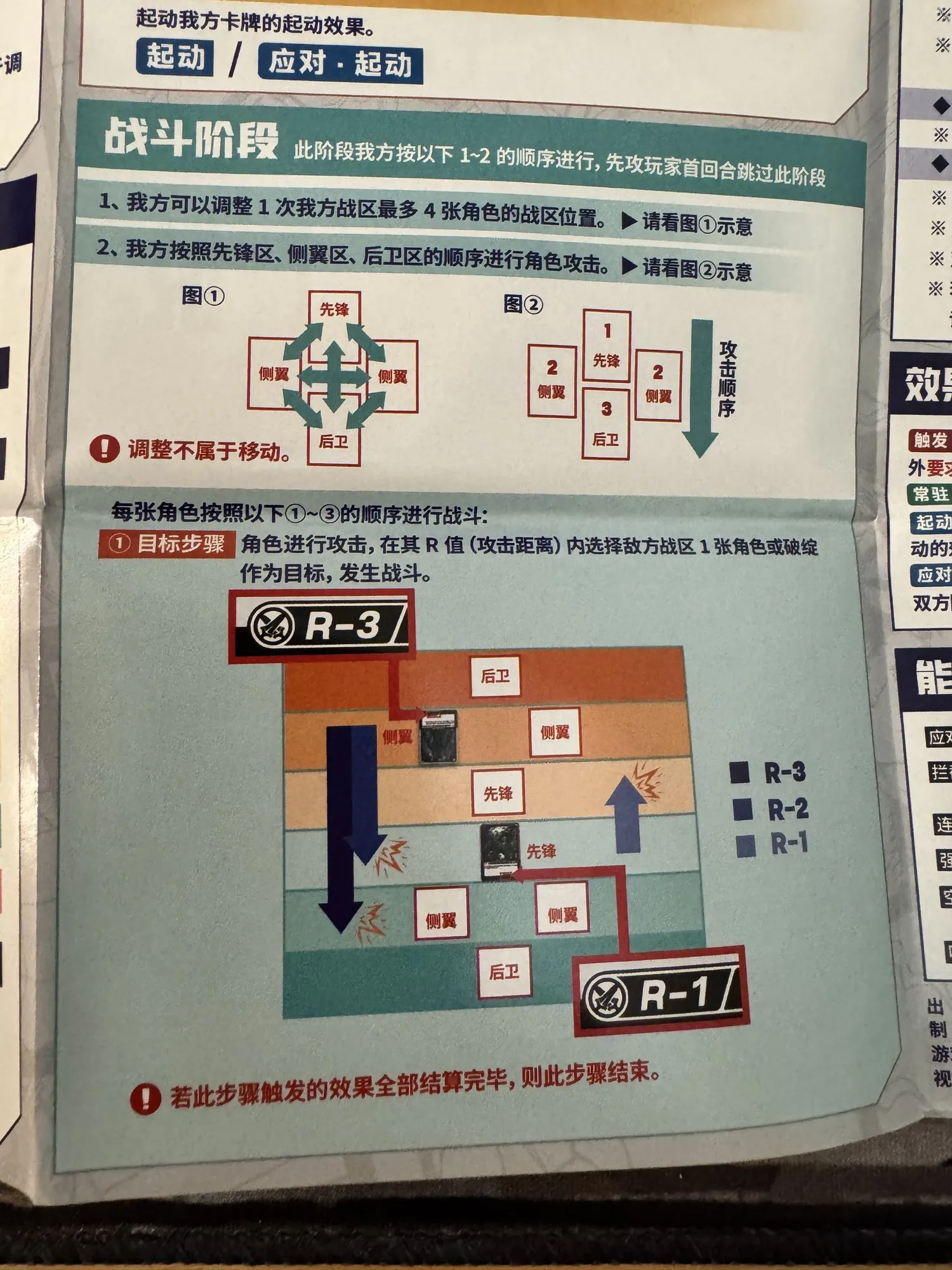
The Battle Phase has two steps.
Step 1 — reposition. Once per turn you may rearrange up to 4 of your characters among your Battle Zones, freely, in any pattern. The book is careful to note 调整不属于移动 — repositioning is not movement, so it doesn’t burn anybody’s Battle/Base move.
Step 2 — attack, in a fixed order: Vanguard first, then Flanks, then Rearguard. If both Flanks are occupied you choose which of the two goes first. Every character in a Battle Zone gets exactly one attack per turn and may decline to attack. Characters sitting in your Base cannot attack at all.
Then each attack resolves in three steps.
① 目标步骤 Target Step. The attacker picks a target within its R value: one enemy character in a Battle Zone, or an Opening. R is measured in ranks into the enemy formation — R-1 reaches only their Vanguard, R-2 reaches the Vanguard and Flanks, R-3 reaches all the way to the Rearguard. A big R-3 hitter can reach past the wall and start punching holes at the back; an R-1 bruiser has to grind through the front door.
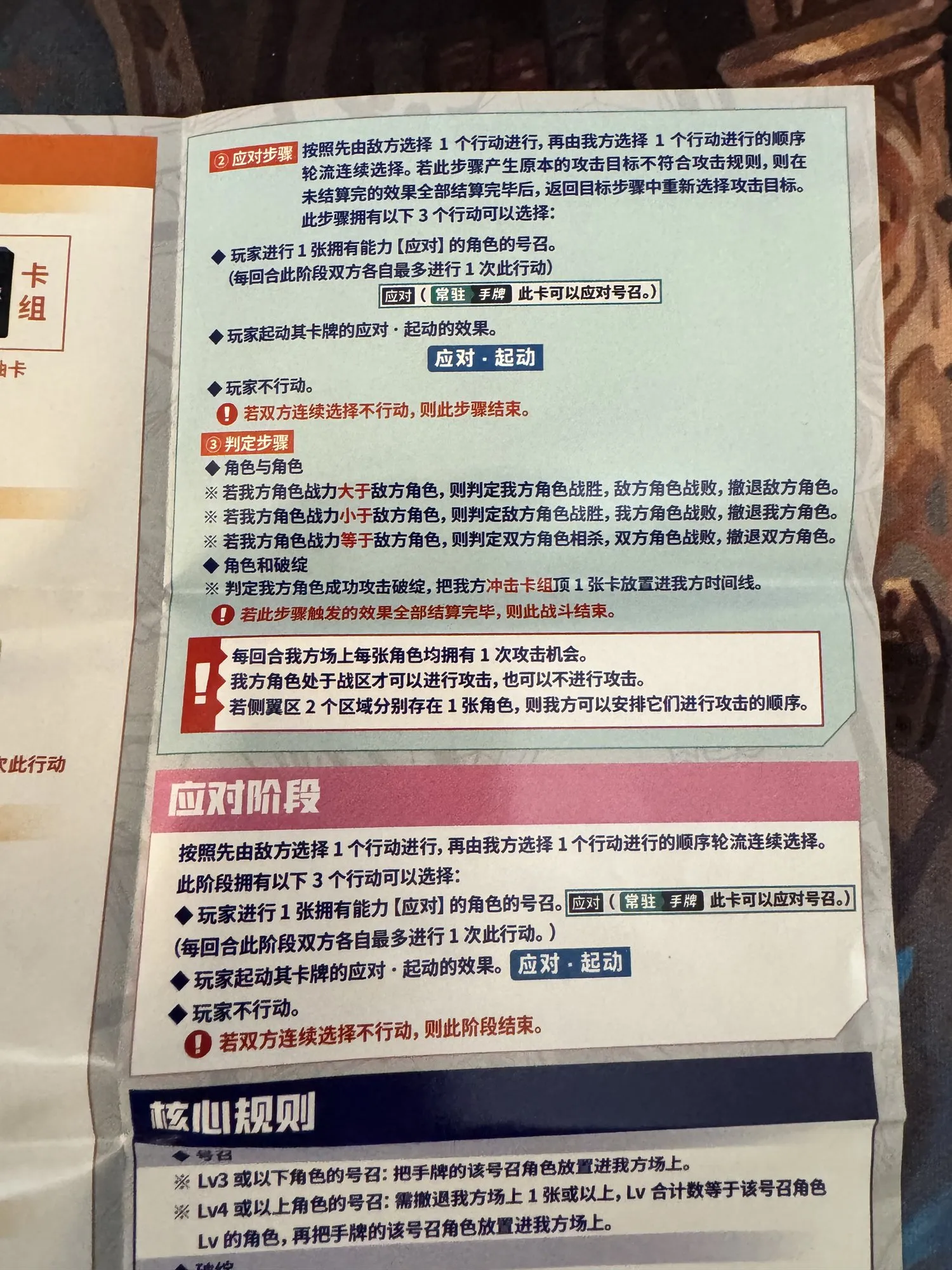
② 应对步骤 Response Step. Same alternating priority as the Response Phase — opponent acts first, then you, until both pass. This is where you flash in a Response character or fire an 应对·起动 effect to change the maths. Nice detail: if something in this step makes the original target illegal, you finish resolving everything and then go back to the Target Step and pick a new target rather than the attack just fizzling.
③ 判定步骤 Resolution Step. Compare numbers.
- Your power greater than theirs → their character is defeated and retreats.
- Your power less than theirs → your character is defeated and retreats.
- Your power equal to theirs → both are defeated and both retreat.
Attacking is genuinely dangerous here. Swing into something bigger and you lose the attacker; there’s no “attacker only deals damage” safety net.
And the payoff line: 角色和破绽 — character versus Opening. 判定我方角色成功攻击破绽,把我方冲击卡组顶1张卡放置进我方时间线。 “Your character successfully attacks the Opening; put the top card of your Rush Deck into your Timeline.” One point. Nine to win.
There’s one more rule in the glossary that surprised me: 若角色战力为0,则撤退该角色 — a character whose Power is reduced to 0 retreats immediately, no combat needed. So power reduction isn’t just a combat trick, it’s removal.
Effect types and keywords
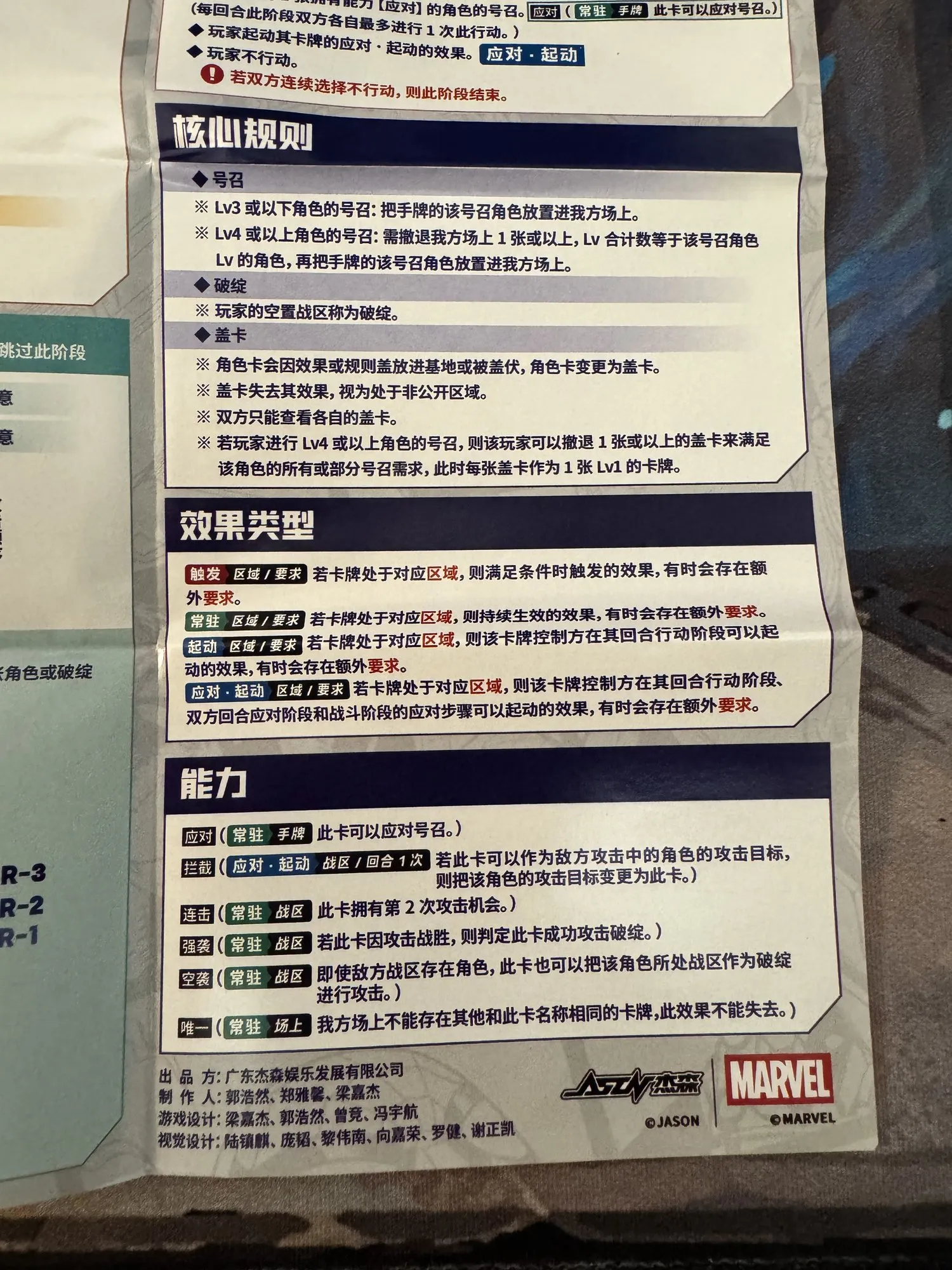
This panel is the one to photograph and keep on your phone, because every card in the game uses this shorthand. Each ability is tagged with when it works and where the card has to be for it to work.
The four effect types (效果类型):
- 触发 Trigger — fires when its condition is met, if the card is in the listed zone.
- 常驻 Continuous — always on while the card is in the listed zone.
- 起动 Activate — the controller may activate it during their own Action Phase.
- 应对·起动 Response Activate — may be activated during either player’s Response Phase, and during the Response Step of a battle. This is your instant-speed.
Each tag carries a zone in brackets — 手牌 (hand), 战区 (Battle Zone), 场上 (field), and so on — and sometimes an extra requirement. An ability tagged 【常驻】【战区】 does nothing while the card is sitting in your Base.
And the six named abilities (能力), which are the actual keywords you’ll memorise:
| Keyword | Tags | What it does |
|---|---|---|
| 应对 Response | 常驻 / 手牌 | This card can be summoned during a Response Step or Response Phase. |
| 拦截 Intercept | 应对·起动 / 战区 / once per turn | If this card would be a legal target of the attacking character, redirect that attack onto this card. |
| 连击 Double Strike | 常驻 / 战区 | This card gets a second attack. |
| 强袭 Assault | 常驻 / 战区 | If this card defeats a character in battle, it also counts as having successfully attacked an Opening. |
| 空袭 Air Raid | 常驻 / 战区 | Even if an enemy Battle Zone is occupied, this card may attack that zone as though it were an Opening. |
| 唯一 Unique | 常驻 / 场上 | You may not have another card with this name on your field. This effect cannot be removed. |
Look at 强袭 and 空袭 again, because those are the two that break the game open. Assault turns a good trade into a point — kill their blocker and score. Air Raid ignores the blocker entirely and scores through a defended zone. Both of them attack the win condition directly rather than attacking the board, and if you’re building a deck, that’s where you start. Intercept is the answer to both: a redirect that drags an attack onto a defender you chose.
The glossary rounds it out with two words you’ll hit constantly on card text. 结附 (attach) stacks one character under another; the attached card sits in the same zone but doesn’t count against that zone’s limit — that’s the rules hole equipment and armour cards live in. 解除 (detach) unstacks it and turns it back into a character.
Reading a real card
That’s every rule in the quick-start book. Now here’s what it looks like when you point all of it at one actual card — the MR alt-art Loki that fell out of the bottom of a starter deck.
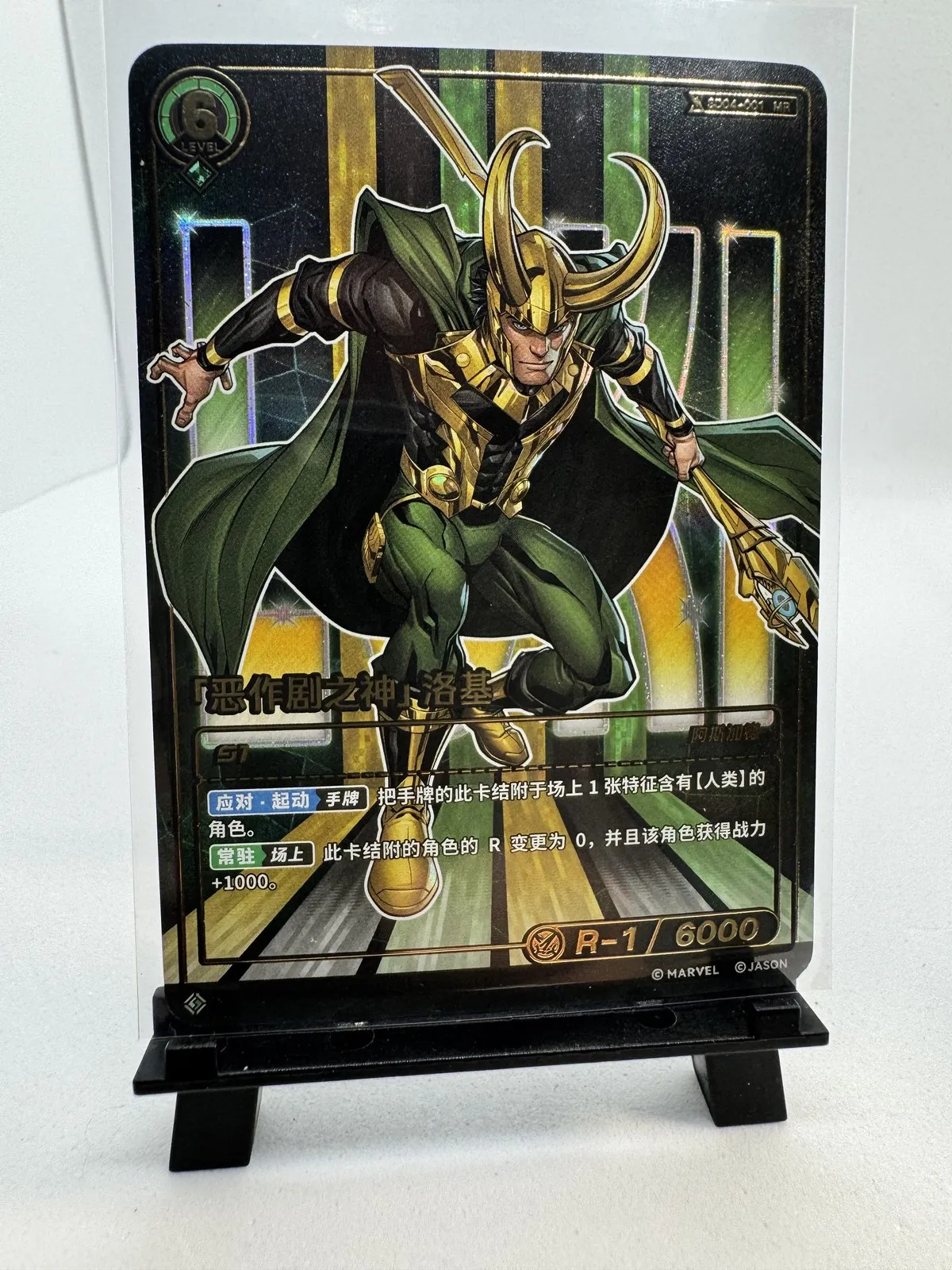
恶作剧之神·洛基 — Loki, God of Mischief. Level 6, green, R-1 / 6000.
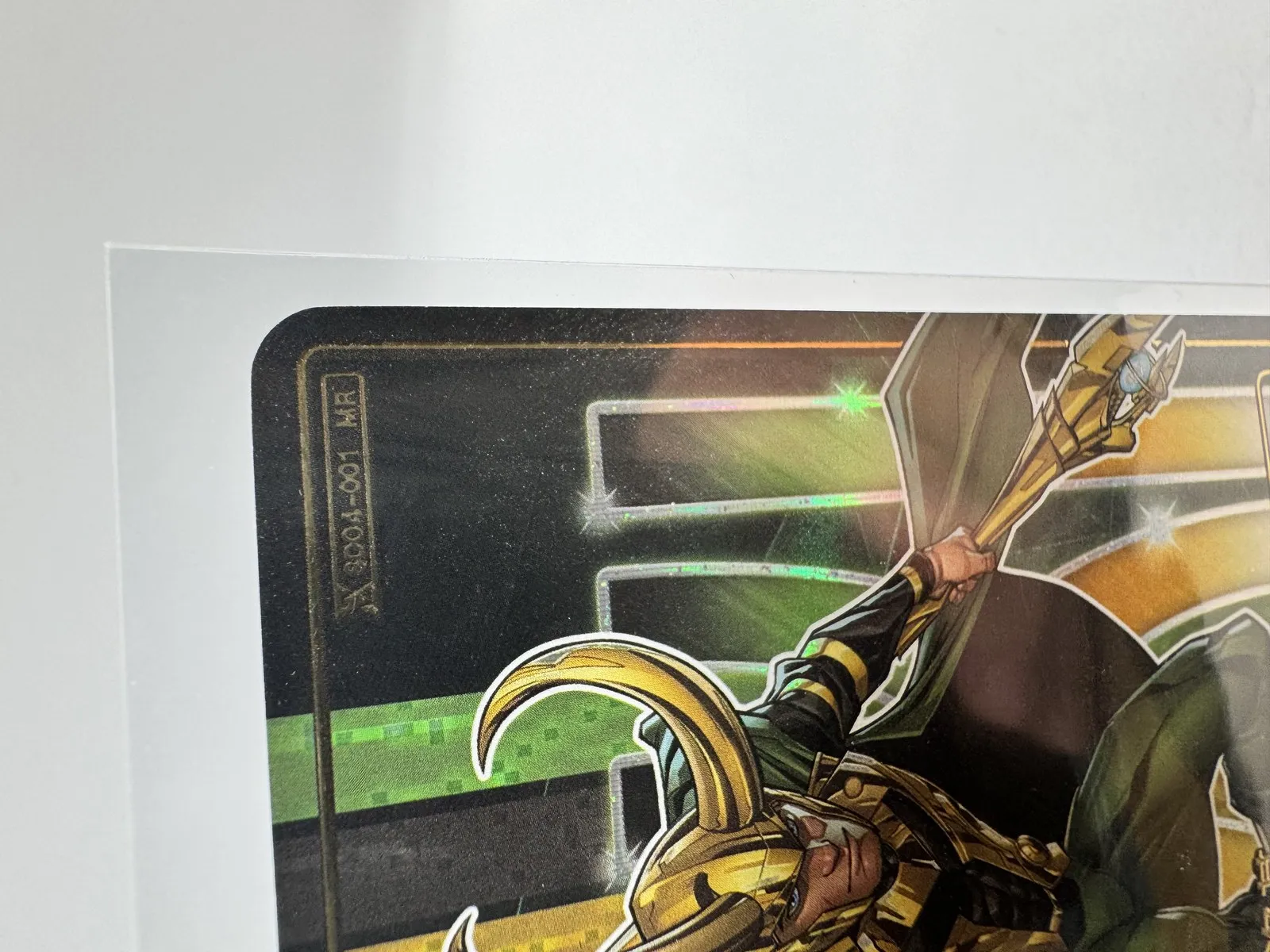
The code in the top corner reads SC04-001 MR, which is exactly where the rulebook told us to look for 编号 and 稀有度 — number and rarity. That MR tag is the alternate-art tier, so somewhere in the set there is a normal-art Loki carrying the same SC04-001 number and the same rules text. They’re the same card for deck building; this one just looks like that.
Now the abilities, which use almost every piece of shorthand in this article:
【应对·起动】【手牌】把手牌的此卡结附于场上1张特征含有【人类】的角色。
[Response Activate][Hand] Attach this card from your hand to a character on the field whose traits include 【Human】.
【常驻】【场上】此卡结附的角色的R变更为0,并且该角色获得战力+1000。
[Continuous][Field] The R of the character this card is attached to becomes 0, and that character gains +1000 Power.
Unpack that and you can see the whole game working:
- 【应对·起动】 means this happens at response speed — during either player’s Response Phase, or mid-combat in the Response Step. So Loki can show up after your opponent has declared an attack and committed to the maths.
- 【手牌】 is the zone tag: it only works from your hand. This is not a character you summon and leave standing around.
- 结附 is attach. Loki goes underneath a Human character rather than taking a slot of his own — and remember the glossary rule, an attached card doesn’t count against the zone’s limit. He can join a full Battle Zone.
- 特征含有【人类】 is the trait requirement, read off the thin strip under the card name. Loki possesses people, so of course he needs a Human.
- +1000 战力 on a 6000-power body is a genuine combat trick at instant speed.
- And then the cost: R becomes 0. A character with no range cannot legally pick a target, so it cannot attack anything — not a character, and not an Opening. It can never score you a Rush Point again.
That last line is the design of the whole game compressed into six characters. Loki makes your hero enormously harder to kill and simultaneously takes them out of the race. You’ve traded a scorer for a wall. In a game you win by punching holes and walking through them, that is a real decision and not a free buff.
It is also a very good Loki, is my point.
If you want it, it’s in my eBay store — though if you’re reading this a while after publication it has probably found a home, in which case there’s usually other Card Fun and Kayou Marvel in there.
How it compares to Hero Battle
I’ve now translated both of these games, and they are much less alike than the shelf suggests.
Hero Battle is a game of hidden information and bluffing. Characters go down face down, you attack blind, you pick a secret supporter, and winning a fight forces you to swap your winner out for your supporter. It’s a psychology game with a card game attached, and I loved it for that.
Hero Rush is a game of position and tempo. Everything is face up in the Battle Zones, nothing is a bluff, and the whole match is a race to open a hole in four slots and then get something with enough range to reach it. Level-4-and-up characters eat your own board to arrive. Repositioning once a turn means the shape of your line is a live decision every single turn. If Hero Battle was poker, Hero Rush is closer to chess with a clock.
The other thing I’ll say, having handled both: the cards are better. Hero Rush is printed on proper blue-core stock with real snap to it, the way a Magic card feels, instead of the thin foiled-paper thing Hero Battle was doing, and the card back finally echoes the comic-book Marvel logo. If you already collect the Hero Battle sets — and I do, obsessively, right down to building the full checklist — you’ll notice the upgrade the second you hold one.
Conclusions
Marvel Hero Rush is a real TCG, not a collector product wearing a rulebook. The Opening/Timeline scoring loop is a genuinely good idea, the bodies-as-currency summoning cost is better than a mana system for a game this size, and the keyword list is tight enough that six words cover almost everything. I’ve read a lot of these rulebooks over the years and this one is unusually well-constructed for a first set.
The barrier is the same as always: it’s Chinese-only, there’s no English printing, and you’re going to be pointing a translation app at card text. That’s less painful than it sounds — the Mandarin on these cards is simple, the effect tags are a closed set of about ten symbols you’ll learn in one evening, and the rulebook photos above cover the shorthand. Learn 号召, 撤退, 破绽 and 战力 and you can read 80% of a card.
If you want to try it, get two starter decks, not a box. Two decks is a complete two-player game with mats and rulebooks in it, and if you’d rather grab everything at once, these are the listings I bought mine from. Then come tell me how your first game went, because I still need somebody to play this with — preferably another Mandarin novice, so we can be confused together.
Second set is already out, by the way: SP01, 蜘蛛纪元 — “Spider Era,” an entirely Spider-Man expansion. That one’s getting its own opening.